The Scalp Microbiome: What the Research Actually Says About the Microbes Living on Your Scalp
November 3, 2026
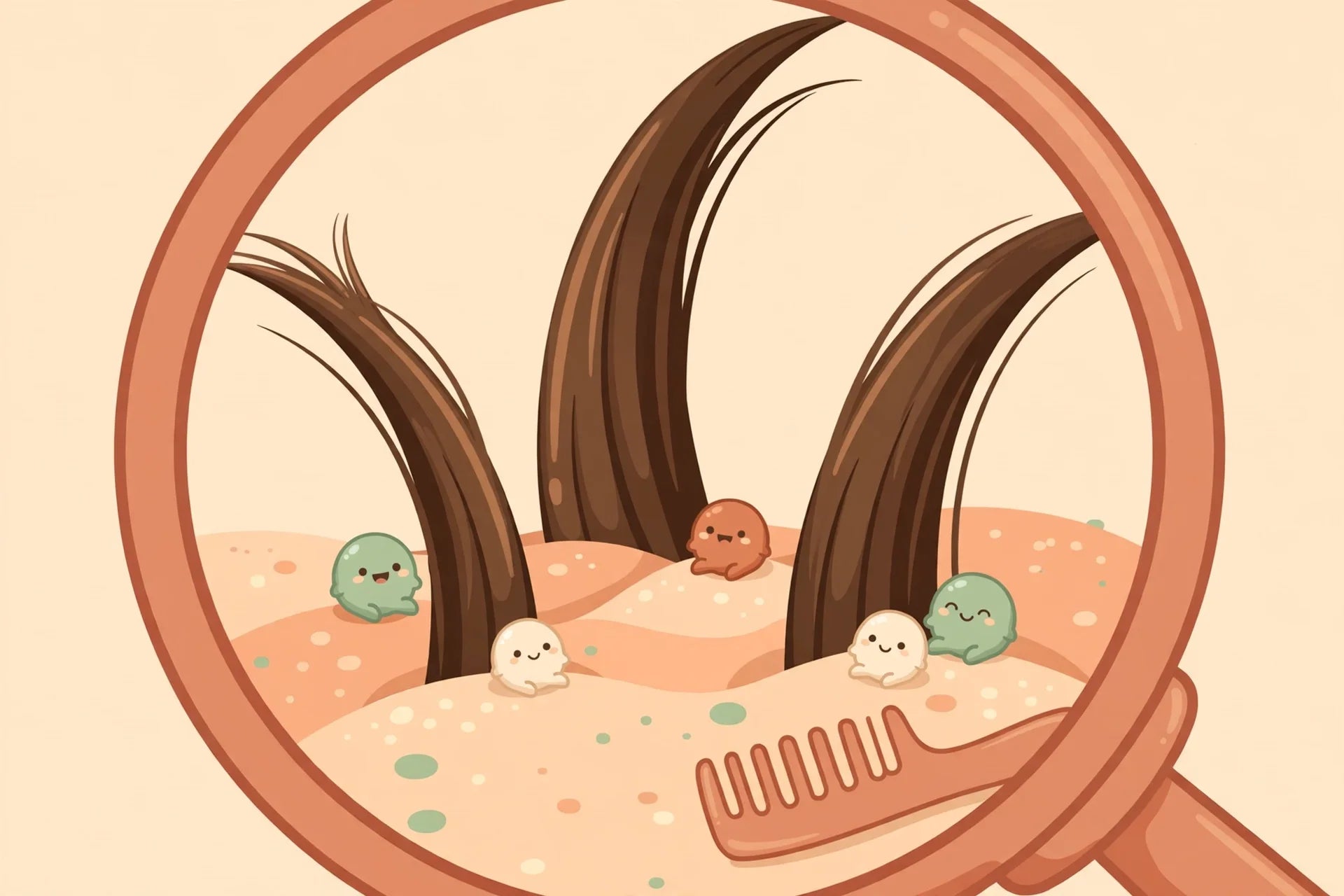
Your scalp is not sterile. Millions of microorganisms live on its surface — bacteria, fungi, and other microscopic residents. Together they form what scientists call the scalp microbiome.
Hair-care companies have started promoting products described as “microbiome-friendly,” “prebiotic,” or “microbiome-balancing.” But what does the research actually show?
Scientists have found relationships between scalp microorganisms, natural oils, skin-barrier conditions, and visible flaking. But understanding those relationships is very different from proving that a cosmetic product can improve the scalp by changing its microbial population. The distinction matters.
What Actually Lives on a Healthy Scalp?
Two important bacterial groups commonly found on the scalp are Cutibacterium and Staphylococcus. Cutibacterium acnes, previously called Propionibacterium acnes, is a normal resident of oil-rich skin. Staphylococcus epidermidis is another common skin bacterium. The scalp also hosts fungi, particularly species of the genus Malassezia.
A molecular analysis by Clavaud and colleagues identified C. acnes, S. epidermidis, and Malassezia restricta among the prominent microorganisms inhabiting the scalp (Clavaud et al., PLOS ONE, 2013). Later investigations confirmed that Cutibacterium, Staphylococcus, and Malassezia are major components of scalp microbial communities (Grimshaw et al., PLOS ONE, 2019).
Importantly, finding these organisms does not automatically indicate a problem. A microorganism associated with flaking in one population may also be present on perfectly comfortable scalps. Different species interact with one another, compete for nutrients, and respond to the chemical environment of the skin.
This makes the popular division between “good bacteria” and “bad bacteria” misleading. The important questions are which organisms are present, how they interact, and how the individual’s scalp responds.
Malassezia: Why Scientists Study This Common Fungus
Malassezia receives considerable attention in scalp research because of its association with dandruff and seborrheic dermatitis. But Malassezia is also commonly found on scalps without any visible flaking, and researchers have investigated whether the relationship involves more than simply the amount of fungus present.
Malassezia species can produce enzymes called lipases, which break down certain fats in sebum — the natural oil produced by the skin. This process releases free fatty acids, some of which may contribute to irritation or changes in skin-barrier behaviour in susceptible individuals.
Research by DeAngelis and colleagues highlighted three interacting factors: Malassezia, sebaceous lipids, and individual sensitivity (DeAngelis et al., Journal of Investigative Dermatology Symposium Proceedings, 2005). This helps explain why two people with similar microbial populations might experience different scalp conditions — a person’s skin barrier, sebum composition, and individual susceptibility may influence the outcome.
A larger observational investigation also found associations between dandruff severity, bacterial populations, scalp sebum, and water content (Xu et al., Scientific Reports, 2016). Notably, bacterial patterns showed strong relationships with dandruff severity in that study. These findings challenge the idea that one microorganism alone explains every case of scalp flaking.
Association does not establish simple causation, and these observations do not demonstrate that changing microbial populations with ordinary cosmetics will improve scalp comfort.
What Changes the Scalp Microbiome?
The scalp microbiome is dynamic rather than permanently fixed. Age, skin physiology, environmental conditions, natural oils, and personal-care practices can all influence its composition.
Washing habits are particularly relevant, because shampoo removes accumulated sebum, debris, and other materials from the scalp surface. In research examining washing frequency, participants reported differences in hair and scalp satisfaction across washing routines (Punyani et al., Skin Appendage Disorders, 2021). Those findings do not establish one ideal washing schedule for everyone, or prove that more frequent washing produces a healthier microbiome.
Different shampoos may also influence microbial measurements. A human study examining two non-antimicrobial shampoo formulations found changes in some microbial counts — fungal numbers in particular increased — but no statistically significant alteration in overall microbial community composition during the two-week application period (Jacksch et al., International Journal of Cosmetic Science, 2024). Changing the number of microorganisms detected is not necessarily the same as fundamentally changing the microbial community.
What About Hair Oils?
Oils can influence the scalp’s surface environment, but their effects should not be generalised. In a study involving 140 Indian women (70 with healthy scalps and 70 with dandruff), researchers applied coconut oil for 12 weeks within a 16-week study that also included a 4-week no-treatment phase, and observed changes in bacterial and fungal community patterns associated with coconut-oil use (Saxena et al., Scientific Reports, 2021).
Those findings suggest that certain oil-based routines may influence measured microbial populations. They do not prove that every coconut-oil formulation produces the same effects, that other botanical oils behave identically, or that oil-based cosmetics permanently improve the microbiome — and the study cannot establish microbiome benefits for an unrelated finished hair mask.
Similarly, leave-on and rinse-off products differ in how long their ingredients remain in contact with the scalp. That difference may be scientifically relevant, but direct comparative evidence demonstrating superior microbiome outcomes from leave-on cosmetic masks remains limited. Styling-product buildup and individual washing practices may also alter the scalp environment, although their precise microbiome effects are not yet sufficiently characterised.
Are “Microbiome-Friendly” Hair Products Scientifically Proven?
The term “microbiome-friendly” sounds precise, but it does not automatically identify a standardised clinical benefit. Some manufacturers use microbiological testing to evaluate whether products substantially alter selected organisms under specific conditions. Such testing can be informative — but a product preserving certain bacterial populations in a laboratory experiment has not necessarily demonstrated improved scalp comfort in people. And a formula that produces a measurable microbial change has not automatically demonstrated that the change is desirable.
Three increasingly common cosmetic terms deserve attention. Prebiotics are substances intended to support selected microorganisms or their activities. Probiotics generally refer to live microorganisms that provide a demonstrated benefit when used appropriately. Postbiotics refer to preparations of inanimate microorganisms or their components that provide a demonstrated benefit. Cosmetic labels sometimes use these terms more loosely than their scientific definitions.
Research involving topical probiotics and postbiotics has produced some promising findings, particularly in skin-care applications. A 2024 review identified 14 published clinical trials involving topical cosmetic preparations containing specific, well-characterised probiotic or postbiotic strains, applied to volunteers with healthy skin (Theodorou et al., Nutrients, 2024). However, this literature largely concerns skin applications rather than evidence that ordinary scalp cosmetics improve hair growth. Results also depend on the exact formulation, microbial strain or preparation, study population, and outcome measured.
Laboratory studies investigating microbial interactions remain early-stage evidence, not proof of benefits in people. And findings involving the gut microbiome cannot simply be transferred to the scalp. A cosmetic label alone cannot establish that a product improves microbial diversity, restores an ideal microbial community, or produces lasting scalp benefits.
Can Scalp Microbiome Research Tell Us Anything About Hair Growth?
Not yet, with the certainty sometimes suggested by advertising.
Researchers have investigated whether scalp microorganisms contribute to local biochemical processes, including the metabolism of nutrients. For example, metagenomic analysis has identified microbial pathways associated with amino-acid and vitamin metabolism (Saxena et al., Frontiers in Cellular and Infection Microbiology, 2018).
But detecting a microbial metabolic pathway does not demonstrate that the resulting substances meaningfully influence human hair growth — and it certainly does not prove that applying a cosmetic product changes those pathways enough to produce visible hair-growth results. The same limitation applies to cosmetic peptides: there is currently insufficient robust human clinical evidence to conclude that a cosmetic copper-peptide hair mask produces hair-growth benefits through modification of the scalp microbiome.
What Can a Cosmetic Hair Mask Honestly Offer?
A well-formulated cosmetic hair mask can provide benefits without claiming to modify microorganisms. Depending on its ingredients and formulation, it may help condition hair, improve softness, reduce friction during grooming, enhance shine, and make strands easier to manage. Products intended for scalp application may also contribute to a moisturised, comfortable-feeling scalp. These are cosmetic outcomes that can be evaluated independently of microbiome claims — a product does not need to alter the scalp’s bacterial or fungal populations to be useful in a hair-care routine.
For persistent, spreading, or painful scalp symptoms, seeking guidance from a qualified clinician is appropriate.
The Bottom Line: A Fascinating Science Still Developing
Scalp-microbiome research has revealed an intricate relationship between microorganisms, sebum, skin-barrier characteristics, and individual variation. But the field remains relatively young compared with gut-microbiome research. Many available studies are observational, involve relatively small populations, or investigate microbial changes without establishing meaningful long-term cosmetic benefits.
There is no universally established ideal scalp microbiome, and no convincing basis for claiming that every person should have the same microbial composition. Most importantly, no cosmetic peptide or microbiome-labelled product has conclusively demonstrated reliable hair-growth or microbiome-rebalancing benefits in people.
For consumers, the most useful approach remains choosing products based on demonstrated cosmetic performance rather than assuming that microbiome-related terminology guarantees additional benefits.
Exploring Copper Peptides in Your Hair-Care Routine
For readers interested in incorporating copper peptides into their cosmetic hair-care routine, the RootMira AHK-Cu Copper Peptide Hair Mask is an option to explore. Formulated with AHK-Cu copper peptides alongside shea butter, coconut oil, castor oil, rosemary, and aloe, it brings together peptide ingredients and traditional conditioning ingredients in a hair mask designed for cosmetic care. It should not be understood as a product proven to change the scalp microbiome or produce hair-growth effects.
RootMira products are cosmetics, not medicines. This article shares general ingredient information, not medical advice.
RootMira's mask is built around AHK-Cu, the copper peptide for hair. See the mask →