Silicones in Hair Products: What the Research Actually Says About Buildup, "Suffocation," and Shine
October 23, 2026
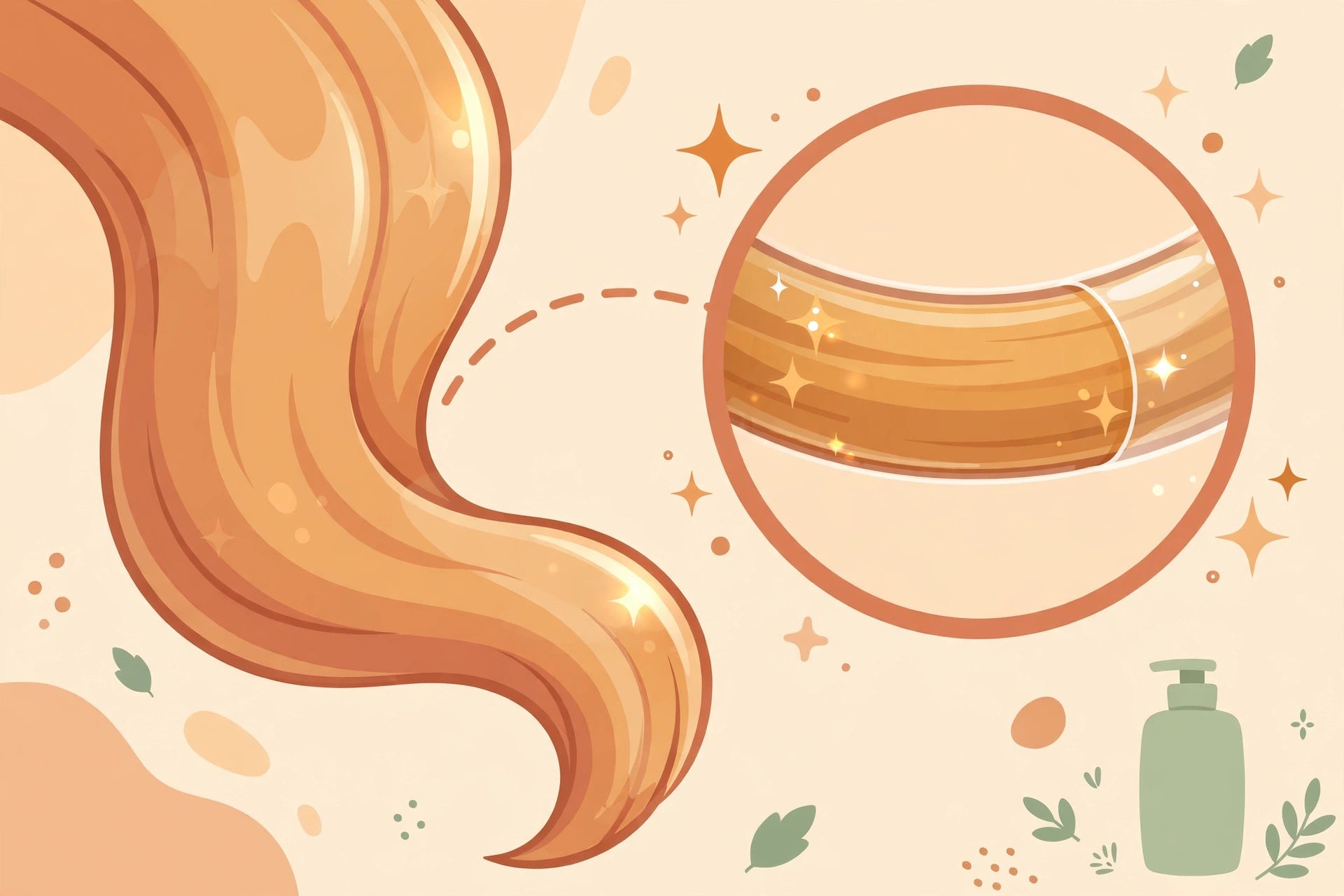
Silicones have become one of the most misunderstood ingredients in hair care. Social media discussions frequently describe them as substances that suffocate hair, create stubborn buildup, and prevent moisture from entering the strands.
Meanwhile, conditioners and styling products continue using silicones for their ability to make hair feel smoother, shinier, and easier to manage.
So which explanation is supported by science?
Published laboratory studies offer a more nuanced answer. Silicones can provide measurable cosmetic benefits, but their performance depends on their chemistry, concentration, formulation, and how frequently the hair is washed.
What Exactly Are Silicones?
Silicones are synthetic polymers built around repeating silicon–oxygen bonds. Their molecular structures can be modified to create liquids, films, and conditioning agents with different properties.
Four categories commonly appear in hair products:
Dimethicone: A nonvolatile silicone used to improve slip, smoothness, and surface lubrication.
Amodimethicone: An amino-functional silicone designed to adhere more effectively to certain hair surfaces, particularly negatively charged areas associated with chemical damage.
Cyclomethicone: A traditional umbrella term for volatile cyclic silicones, including D4 (cyclotetrasiloxane), D5 (cyclopentasiloxane), and D6 (cyclohexasiloxane). These materials evaporate at different rates after application.
PEG-modified silicones: Silicone molecules containing polyethylene glycol groups that increase their compatibility with water. Their solubility and rinsing behavior depend on the specific molecular structure.
Formulators use these ingredients primarily to modify the outer surface of hair fibers.
Using atomic force microscopy, researchers measured conditioner films and their interactions with the hair surface, demonstrating that deposited conditioning materials alter measurable surface properties (Chen and Bhushan, Journal of Microscopy, 2006).
This is surface conditioning—not biological nourishment or internal reconstruction.
Can Silicones Really Suffocate Hair?
The idea that silicones suffocate hair misunderstands basic hair biology.
The visible hair shaft consists primarily of keratinized, nonliving cells. Unlike the living cells inside the hair follicle, the shaft does not breathe, consume oxygen, or perform cellular metabolism.
Consequently, coating the hair shaft cannot suffocate it.
What silicone films can do is change surface wettability, friction, and interactions with moisture.
Many silicones are hydrophobic, meaning they repel liquid water. A hydrophobic coating can influence how readily water contacts the fiber and, depending on the formulation, alter moisture exchange.
However, hydrophobic does not mean completely waterproof or hermetically sealed.
Research on human hair demonstrates that water sorption depends on the complex structure and chemical interactions within keratin fibers (Breakspear et al., International Journal of Cosmetic Science, 2022).
It would therefore be inaccurate to claim that a silicone coating permanently prevents hair from receiving moisture.
Equally, moisture-related effects should not automatically be described as restoration. Controlling surface behavior is different from repairing the internal protein structure.
Silicone Buildup: What the Experiments Actually Show
Buildup is a real phenomenon, but it is not inevitable or permanent.
Nonvolatile silicones can remain on hair after application. When products are applied repeatedly, especially without effective cleansing, the amount deposited may increase.
Researchers examining silicone deposition from shampoo formulations found that certain systems accumulated silicone during repeated washing. Interestingly, adding specific cationic polymers significantly reduced this buildup, demonstrating that formulation chemistry matters (Gruber et al., The Use of X-Ray Fluorescence Spectroscopy to Study the Influence of Cationic Polymers on Silicone Oil Deposition from Shampoo, Journal of Cosmetic Science, 2001; Gruber et al., Colloids and Surfaces B, 2000).
Other research documented silicone deposition from commercial shampoos, repeated applications, and removability using sodium laureth sulfate, a common cleansing surfactant (Determination of the Substantivity of Emollients to Human Hair, Journal of Cosmetic Science, 2007).
Earlier work on two-in-one shampoos likewise described how subsequent cleansing could remove previously deposited dimethicone while allowing fresh conditioning material to deposit (Rushton et al., Skin Pharmacology, 1994).
These findings challenge the popular claim that silicones create an indestructible coating.
However, shampoo removal is not universally complete. Different silicones, product concentrations, and cleansing formulations produce different results.
The most scientifically defensible conclusion is that silicone accumulation is a manageable formulation-and-washing issue, not an irreversible change to the hair fiber.
Why Different Silicones Behave Differently
Treating all silicones as identical obscures some important chemistry.
Dimethicone is typically nonvolatile and can remain on the surface until removed.
Volatile cyclic silicones, including D4, D5, and D6, progressively evaporate rather than functioning as persistent conditioning films in the same way. Evaporation rates vary, and a finished product may contain other ingredients that remain behind.
Amodimethicone behaves differently because its amino groups can promote interactions with negatively charged hair surfaces.
Laboratory experiments found that amino-functional silicone softeners deposited more effectively than conventional polydimethylsiloxane under certain conditions and produced larger reductions in combing force (Lim et al., Fibers and Polymers, 2010).
That does not establish that every amodimethicone formulation deposits exclusively on damaged areas. Selectivity depends on the overall formulation and the condition of the hair.
PEG-modified silicones introduce water-compatible molecular groups. Some disperse or dissolve more readily in water, potentially making removal easier.
But “PEG-modified” is not a universal guarantee of complete water solubility.
The Environmental Concern Is a Separate Scientific Question
Some cyclic silicones have attracted regulatory attention because of environmental persistence and bioaccumulation concerns.
European Commission Regulation (EU) 2018/35 restricted D4 and D5 in wash-off cosmetic products at concentrations of 0.1% or greater, applicable from January 31, 2020.
The EU subsequently adopted Regulation (EU) 2024/1328, extending restrictions to D4, D5, and D6, with the broader restrictions applying from 6 June 2026 and, for many leave-on cosmetics, 6 June 2027.
These restrictions address environmental risks associated with the substances and their release.
They should not be presented as scientific proof that silicones damage hair fibers, suffocate follicles, or cause hair loss.
Environmental sustainability, consumer safety, and cosmetic hair performance are related but distinct questions.
Does Silicone Actually Make Hair Shinier?
Yes, some silicone formulations can improve shine, but the mechanism is optical rather than biological.
Light reflects more uniformly from relatively smooth, orderly hair surfaces. Roughness, misaligned fibers, and irregular surface deposits scatter light in different directions, reducing the appearance of gloss.
Silicone conditioning films can reduce friction and improve surface smoothness, helping hair look more polished.
These effects can be investigated through combing-force measurements, surface analysis, and instrumental gloss testing.
In laboratory research, amino-functional silicones reduced combing forces (Lim et al., Fibers and Polymers, 2010).
This is an important reminder that more conditioning material does not necessarily mean more shine: a heavier, uneven film can scatter light instead of reflecting it uniformly, so luster depends on the formulation and treatment conditions, not just on how much silicone is applied.
Research has also demonstrated instrumental methods for measuring hair shine and surface smoothness, although the performance of one conditioning formulation cannot automatically be attributed to silicones generally (Gao et al., Journal of Cosmetic Science, 2009).
These are measurable cosmetic effects, not evidence of internal hair repair or stimulation of hair growth.
What About Breakage and Manageability?
Lower friction can make strands easier to separate during brushing and combing.
Laboratory evaluations of silicone-containing shampoos have measured improvements in combing force and flyaway control, alongside tests of hair breakage and mechanical properties (Li et al., Journal of Cosmetic Science, 2022).
Such results support the use of silicones as cosmetic conditioning ingredients.
However, most of the directly relevant evidence comes from laboratory testing of treated hair fibers and tresses, not long-term randomized clinical trials involving people.
Improved combability may help reduce mechanical stress during grooming, but it should not be confused with permanent strengthening or rebuilding of the hair’s internal structure.
The Practical Verdict: Do You Need Silicones?
Silicones are effective cosmetic conditioning ingredients, but they are not essential for healthy-looking hair.
They can improve slip, manageability, surface smoothness, frizz control, and shine when appropriately formulated.
Some silicone films can accumulate with repeated use. Regular cleansing, and occasional clarifying when products feel excessively heavy, can help manage unwanted residue.
A silicone-free formulation can also perform well using alternative conditioning agents.
Choosing silicone-free hair care is therefore a formulation and personal-performance preference—not a universal safety requirement.
The published evidence reviewed here does not establish that normal cosmetic silicone use blocks hair growth, damages follicles, or causes hair loss.
For readers interested in exploring other cosmetic hair-care ingredients, the RootMira AHK-Cu Copper Peptide Hair Mask offers a copper-peptide-containing option to incorporate into a conditioning routine. Its overall cosmetic performance should be evaluated as a finished formulation, rather than assuming that copper peptides deliver clinically established hair-growth or internal-repair benefits.
RootMira products are cosmetics, not medicines. This article shares general ingredient information, not medical advice.
RootMira's mask is built around AHK-Cu, the copper peptide for hair. See the mask →