Shea Butter for Hair: What the Research Actually Says About the “Miracle Moisturizer” Claim
November 3, 2026
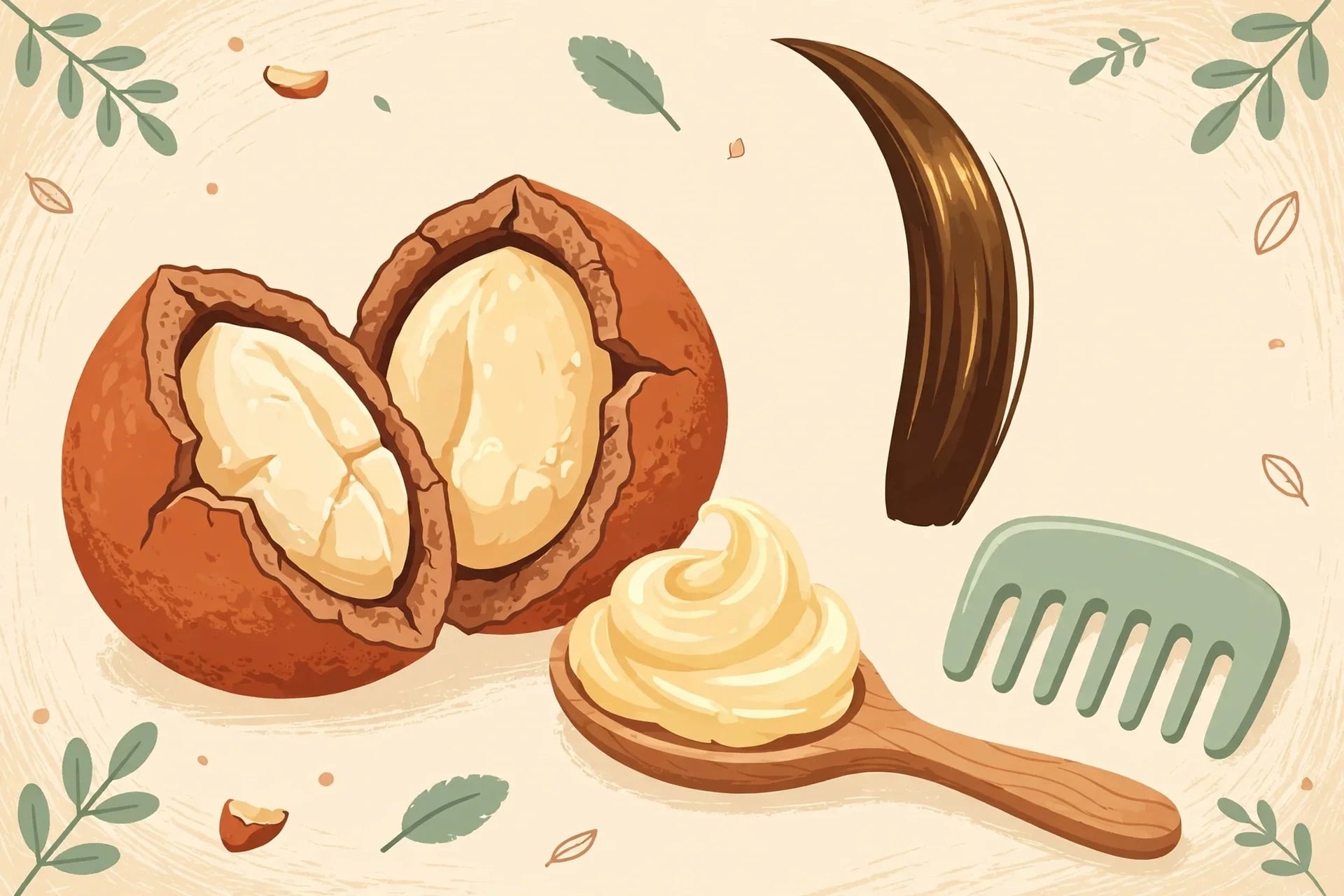
Shea butter has become a staple of hair masks, conditioners, and products designed for dry or textured hair. Its reputation is impressive: intense moisture, softer strands, less breakage, and even claims of stronger, healthier-growing hair.
But how much of that reputation is supported by published research? The answer is more complicated than the marketing suggests. Shea butter has a scientifically credible role as an emollient and conditioning ingredient. However, direct research demonstrating its effects on human hair is surprisingly limited. Understanding the difference between conditioning hair and structurally repairing it is essential.
What Exactly Is Shea Butter?
Shea butter is a plant-derived fat extracted from the nuts of the African shea tree (Vitellaria paradoxa). Its composition is dominated by two fatty acids:
- Oleic acid: a monounsaturated fatty acid that contributes softness and spreadability.
- Stearic acid: a saturated fatty acid that gives shea butter much of its characteristic firmness.
Shea butter also contains smaller quantities of unsaponifiable compounds, including triterpenes, phytosterols, and tocopherols (vitamin E compounds) — substances that remain after the main fats undergo saponification, the chemical reaction used in soapmaking. Laboratory analyses confirm that shea butter’s composition varies with geographic origin, extraction methods, and processing (Maranz and Wiesman, Journal of Agricultural and Food Chemistry, 2004; Abdel-Razek et al., Foods, 2023).
Raw vs. Refined: Does It Matter?
Yes — chemically. Unrefined shea butter generally retains more of its original colour, aroma, and minor constituents. Refining can remove impurities, odours, pigments, and some naturally occurring compounds, although it does not necessarily eliminate all beneficial minor constituents. A 2023 laboratory investigation found that different refined shea fractions retained markedly different concentrations of tocopherols and sterols (Abdel-Razek et al., Foods, 2023).
Importantly, more unrefined does not automatically mean better hair performance. Consumers may find shea listed as Butyrospermum Parkii (Shea) Butter on ingredient labels. This name alone does not establish its refining history, concentration, or conditioning performance.
How Shea Butter Is Supposed to Work on Hair
Hair fibres consist primarily of keratin, a structural protein. Unlike living skin, the visible hair shaft cannot biologically regenerate damaged structures — so shea butter is best understood as a potential surface-conditioning ingredient. Its fatty components can form a lubricating coating that may reduce roughness and improve how strands slide against one another.
This matters because friction, tangling, and repeated combing contribute to mechanical damage. Research investigating hair breakage has demonstrated that snagging, impact forces, and abrasion are important mechanisms behind fibre fragmentation (Robbins, Journal of Cosmetic Science, 2006). A suitable conditioning film could plausibly reduce some of these stresses.
However, a plausible mechanism is not the same as a demonstrated shea-butter benefit. A 2009 study evaluated five Brazilian oils and three Brazilian plant butters on human hair tresses, measuring combing behaviour, gloss, split-end formation, and mechanical properties. Oils reduced wet-combing forces, while the tested butters did not demonstrate equivalent conditioning advantages, and most treatments had little effect on tensile properties (Fregonesi et al., Journal of Cosmetic Science, 2009).
Crucially, the butters were not shea butter. The study illustrates why individual oils and butters must be tested rather than assumed interchangeable.
Does Shea Butter Penetrate the Hair Shaft?
There is insufficient direct evidence establishing meaningful penetration of shea butter into human hair. This contrasts with coconut oil: controlled hair-fibre research found that coconut oil reduced protein loss from damaged and undamaged hair, with researchers attributing its performance partly to its ability to penetrate the fibre (Rele and Mohile, Journal of Cosmetic Science, 2003).
Those findings cannot automatically be transferred to shea butter. Its most defensible cosmetic role remains surface conditioning rather than demonstrated internal reconstruction.
The Moisture Question: Hydration vs. Moisture Sealing
One of shea butter’s biggest selling points is deep moisture. But oils and butters do not function like water-based humectants. Humectants, including glycerin, help attract or retain water; fat-rich emollients can improve surface lubrication and influence moisture exchange. Shea butter may help reduce the feeling of dryness by coating the fibre and limiting friction.
However, describing it as delivering water deep into the hair shaft oversimplifies the chemistry. Hair-fibre moisture content, surface softness, and perceived hydration are different measurements — and direct, controlled studies establishing how much pure shea butter changes hair-fibre water content or moisture retention remain limited. Softer-feeling hair is not necessarily more hydrated internally.
The Skin-Evidence Trap
Shea butter has more published evidence relating to skin than hair. These findings are frequently used to justify hair-care claims, but the two tissues are biologically different.
A human study involving 20 participants evaluated two moisturising formulations containing multiple ingredients, including shea butter in one formulation. Researchers measured skin hydration, transepidermal water loss, and other barrier-related parameters. The formulations demonstrated moisturising effects, but the study did not isolate shea butter’s individual contribution (Samadi et al., Health Science Reports, 2021).
Another laboratory investigation evaluated a cream containing shea butter, silk-derived ingredients, and vitamin E in cultured human keratinocyte cells (Mohanan et al., International Journal of Cosmetic Science, 2025). These were living skin cells, not hair fibres — and the findings concern a multi-ingredient cream, remaining laboratory evidence rather than proof of benefits in people using shea butter on their hair.
Living skin contains metabolically active cells and mechanisms for maintaining its protective barrier. The visible hair shaft consists of nonliving keratinised material. A substance that improves skin-barrier measurements does not necessarily penetrate hair, reduce hair breakage, or rebuild damaged cuticles. Skin moisturising evidence is not hair-repair evidence.
Can Shea Butter Repair Damage or Improve Hair Growth?
There is no convincing published human clinical evidence demonstrating that topical shea butter independently increases hair density, changes the hair-growth cycle, or produces measurable improvements in hair growth. Likewise, evidence does not establish that shea butter permanently restores split ends or rebuilds damaged internal hair structures.
This does not make shea butter useless — cosmetic improvements can still be valuable. By improving lubrication and manageability, an appropriately formulated conditioning product may reduce mechanical stress during detangling. However, direct long-term human trials demonstrating reduced breakage specifically from shea butter are lacking. When advertising describes hair as “repaired,” the observable result may simply be improved smoothness, softness, shine, or appearance. These temporary improvements should not be confused with permanent structural restoration.
Shea Butter vs. Coconut, Argan, and Jojoba Oil
Shea butter’s relatively solid, rich texture distinguishes it from many liquid oils. Coconut oil has published evidence supporting fibre penetration and reduced protein loss (Rele and Mohile, Journal of Cosmetic Science, 2003). Argan oil is commonly used for surface conditioning and cosmetic shine, although rigorous comparative hair studies remain limited. Jojoba oil is chemically unusual because it consists predominantly of liquid wax esters rather than conventional triglycerides. These compositional differences influence how products spread and behave on hair.
For fine hair, heavy shea-rich formulations may produce unwanted weight, reduced volume, or a coated feeling. Coarse, curly, or tightly textured hair may tolerate or benefit from richer conditioning textures, particularly where detangling requires additional lubrication. These are formulation-dependent practical observations, not conclusions established by large comparative trials.
More butter is not necessarily better. Excessive application can leave residue, contribute to buildup, and reduce the lightness or movement of the hair.
What the Research Still Cannot Tell Us
Several important evidence gaps remain. First, there are few robust, shea-specific studies measuring hair-fibre moisture retention, combing force, breakage, and manageability under controlled conditions. Second, long-term clinical trials evaluating shea-containing hair products on people’s heads are lacking. Third, there is no established, evidence-based universal concentration or application amount for shea butter in hair care — a concentration tested in a laboratory cannot automatically be equated with the amount deposited by a finished conditioner or mask. Finally, surface-deposited conditioning ingredients are progressively removed through washing and everyday wear; their benefits require maintenance rather than providing a permanent change in hair structure.
Safety and Tolerability
Shea-derived cosmetic ingredients are generally well tolerated at typical cosmetic use levels. A published safety assessment reviewed irritation and sensitisation data, including human testing of shea-containing formulations, and found support for their safety under the reported cosmetic conditions of use (Burnett et al., International Journal of Toxicology, 2024). Nevertheless, individual reactions remain possible, and people with sensitive scalps should consider patch-testing a new product before widespread application.
Shea also raises a legitimate allergy question because it originates from a tree nut. A published investigation found no detectable IgE-binding soluble proteins in the shea-butter extracts examined (Chawla et al., Journal of Allergy and Clinical Immunology, 2011). This supports the view that refined shea butter generally presents low allergenic-protein exposure, but it does not establish absolute safety for every preparation or individual. Anyone with a known nut allergy should consult their clinician before using an unfamiliar shea-containing product.
The Verdict: Useful Conditioner, Not a Miracle
Shea butter deserves its place in hair-care formulations primarily because of its rich emollient properties and potential to improve softness, lubrication, and manageability. It may support gentler grooming when included in a well-designed conditioning formula.
However, claims about permanent repair, increased hair density, deep structural restoration, or dramatic hair transformation exceed the available evidence. Even its potential to reduce breakage through easier combing requires stronger shea-specific testing. The most scientifically defensible conclusion is straightforward: shea butter is a useful cosmetic conditioning ingredient, but its reputation as a miracle hair transformer remains substantially ahead of the research.
For readers interested in combining rich conditioning ingredients with copper-peptide technology, the RootMira AHK-Cu Copper Peptide Hair Mask contains shea butter alongside coconut oil, castor oil, rosemary, aloe, and AHK-Cu copper peptides. It offers a cosmetic option for those seeking softer-feeling, more manageable hair and conditioning care — without implying that the ingredient combination has been clinically demonstrated to increase hair growth or reverse structural damage.
RootMira products are cosmetics, not medicines. This article shares general ingredient information, not medical advice.
RootMira's mask is built around AHK-Cu, the copper peptide for hair. See the mask →