Protein vs Peptides for Hair: What's Actually the Difference — Hydrolyzed Keratin, Signal Peptides, and What Each One Really Does
October 20, 2026
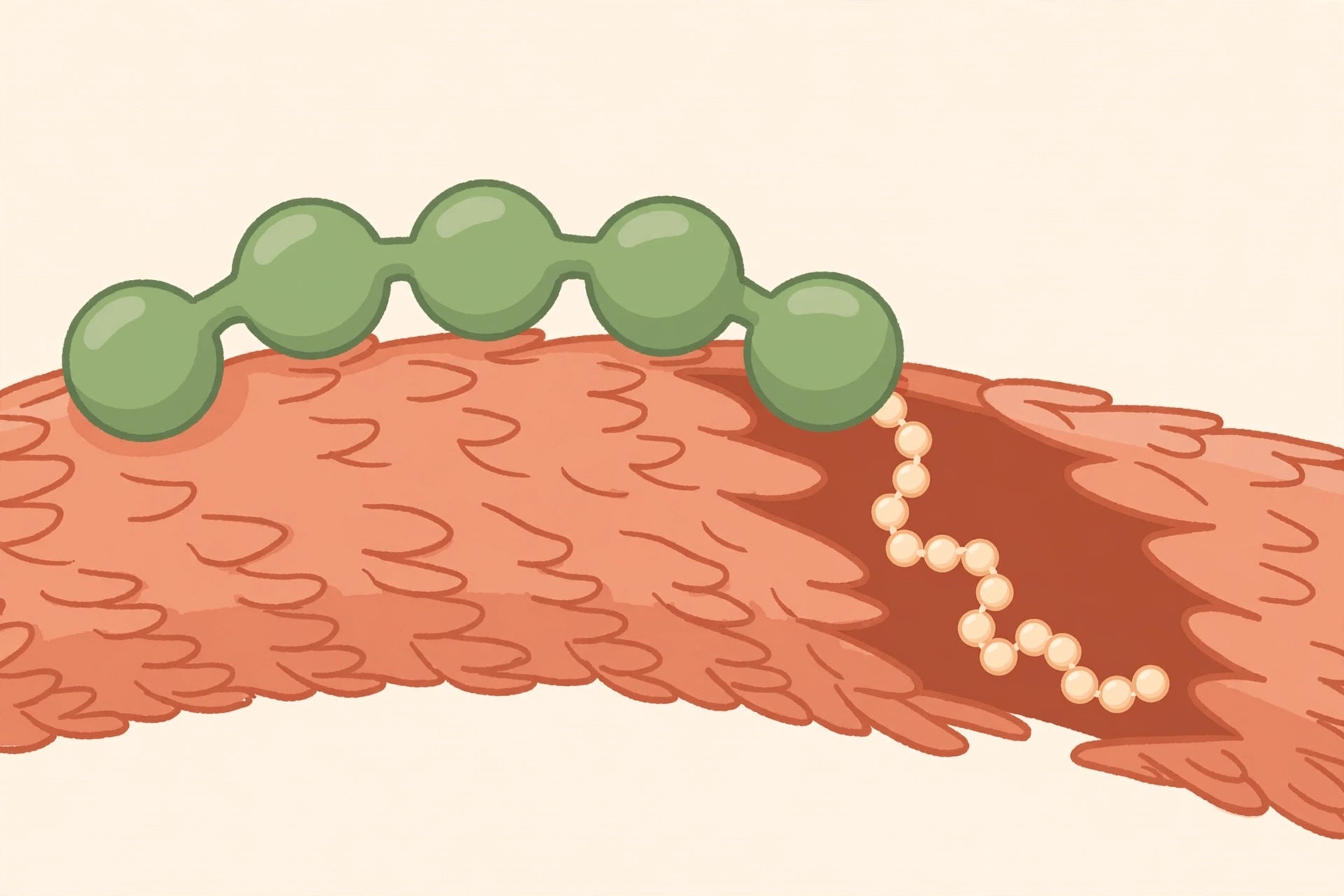
Walk down the hair-care aisle and you’ll find protein masks, keratin treatments, peptide serums, and products promising the benefits of all three. The terminology sounds scientific, but it creates a surprisingly common misunderstanding: Are proteins and peptides basically the same thing?
Chemically, they’re related. Functionally, they can be quite different.
A hydrolyzed protein conditioner primarily interacts with the hair fiber. A cosmetic signal or carrier peptide is generally designed around interactions with living cells. Understanding that distinction makes it easier to separate meaningful ingredient science from ambitious marketing.
First, Understand the Size Ladder
Proteins and peptides are constructed from amino acids, small molecules connected by chemical bonds.
Think of them as building blocks. An amino acid is one individual building block, typically around 75–200 daltons (Da); a peptide is a relatively short chain of amino acids, commonly hundreds to several thousand daltons; a protein is a larger, folded amino-acid chain, often weighing tens of thousands of daltons or more.
These categories overlap. There is no universally fixed molecular-weight cutoff separating peptides from proteins.
Size matters because hair fibers have a protective outer cuticle surrounding an internal cortex. Larger molecules generally have difficulty moving through this structure, while some smaller molecules can enter under suitable conditions.
However, molecular weight is only part of the story. Charge, shape, formulation, hair condition, and exposure time also influence penetration.
What Does “Hydrolyzed Protein” Actually Mean?
When a label lists Hydrolyzed Keratin, Hydrolyzed Wheat Protein, Hydrolyzed Soy Protein, or Hydrolyzed Silk, it generally describes protein material that has been broken into smaller fragments.
This process is called hydrolysis.
Manufacturers use hydrolysis to produce smaller, more formulation-friendly molecules, often improving water compatibility and influencing how ingredients interact with hair.
Importantly, these fragments are not necessarily intact proteins anymore. Depending on processing, the resulting mixture may contain amino acids, small peptides, and larger protein fragments.
The source matters, but so does the molecular-weight distribution.
Two products containing Hydrolyzed Keratin can behave differently if their ingredient fragments have different sizes.
That distinction was demonstrated in published research comparing hydrolyzed keratins of different molecular weights (Malinauskyte et al., International Journal of Cosmetic Science, 2021).
What Protein Products Actually Do to Hair
Protein-containing conditioners can create a temporary coating on the hair fiber, helping modify surface feel, friction, and manageability.
Depending on the formulation, this may contribute to smoother, more conditioned strands; a temporary sensation of fullness or firmness; improved combing and manageability; and reduced mechanical breakage during handling.
Certain protein fragments can also interact with regions beneath the outermost surface.
In the 2021 Malinauskyte study, investigators applied hydrolyzed keratin fractions to chemically relaxed, textured hair and measured changes in physical properties.
Some fractions improved mechanical performance, including resistance to premature fracture.
These were laboratory measurements on isolated hair fibers, not a human clinical trial demonstrating long-term cosmetic outcomes.
The effects also should not be interpreted as permanent structural restoration. Deposited conditioning materials gradually diminish through washing, wear, and grooming, although persistence varies by formulation.
A protein product can make hair feel stronger without replacing the original keratin architecture formed inside the follicle.
Can Small Peptides Actually Enter the Hair Cortex?
Yes, under specific experimental conditions.
Malinauskyte and colleagues compared hydrolyzed keratin fractions averaging approximately 221 Da, 2,577 Da, and 75,440 Da.
They found that smaller fractions could reach deeper regions of chemically relaxed hair, while the largest fraction remained predominantly near the surface.
The study also showed something important: penetration does not automatically equal better performance.
The smallest fraction influenced hair swelling but did not demonstrate the same mechanical benefits as certain larger fractions.
Meanwhile, some larger fragments improved mechanical measurements despite remaining closer to the surface.
This challenges the popular assumption that an ingredient must penetrate deeply to provide worthwhile cosmetic benefits.
It also highlights a frequently overlooked distinction: these were keratin-derived peptides interacting with nonliving hair fibers, not signal peptides communicating with living scalp cells.
Why Hair Cannot Simply Be Reconstructed
The visible hair shaft consists of highly keratinized, nonliving cells.
Unlike living skin, it has no ongoing cellular machinery capable of manufacturing new structural proteins or restoring its original biological architecture.
Once hair emerges from the scalp, its fundamental structure is already established.
Cosmetic ingredients can coat, lubricate, penetrate, and modify its physical properties. Some formulations measurably improve resistance to breakage.
But those outcomes are different from creating a new, naturally formed hair shaft.
A useful illustration comes from Di Foggia and colleagues, who investigated chemical formulations marketed around restoring structural bonds in damaged hair.
Using infrared and Raman spectroscopy, they observed changes in treated fibers but found no increase in disulfide-bond content within the cortex (Di Foggia et al., International Journal of Biological Macromolecules, 2021).
Disulfide bonds are important chemical connections contributing to keratin’s structural characteristics.
The study did not examine ordinary hydrolyzed-protein conditioners, and it cannot establish that every bond-focused technology behaves identically. It does demonstrate why cosmetic structural claims require direct chemical evidence, rather than relying only on smoother-looking hair.
Signal Peptides: A Different Scientific Idea
Signal peptides in cosmetics are designed around biological communication.
In plain language, certain peptide sequences can interact with cellular pathways, potentially influencing how living cells behave.
Research on cosmetic peptides has explored cellular responses involving extracellular-matrix components and other biological processes.
However, much of this mechanistic research concerns skin cells, laboratory systems, or early-stage experimental models.
Evidence for meaningful benefits from finished scalp products remains considerably more limited.
A 2016 scientific review emphasized both the biological possibilities and the challenges of peptide delivery and weak clinical evidence for many cosmetic applications (Schagen, Cosmetics, 2017).
A laboratory response is not proof that a rinse-off product produces the same response on a person’s scalp.
Carrier Peptides: What Makes Copper Peptides Different?
Carrier peptides are associated with binding and transporting substances such as copper ions.
Copper peptides include GHK-Cu and AHK-Cu, which are distinct molecules with different amino-acid sequences.
AHK-Cu has been investigated in cultured human dermal papilla cells and isolated human hair follicles.
One published study observed biological responses under controlled laboratory conditions (Pyo et al., Archives of Pharmacal Research, 2007).
These findings are interesting but early-stage, not proven cosmetic benefits in people.
They do not establish that an ordinary copper-peptide hair mask produces comparable responses during real-world use.
Copper-peptide formulas should therefore be evaluated for practical cosmetic qualities, including conditioning, softness, ease of application, and scalp-care experience.
Decoding the Label Word Games
Some ingredient names sound more sophisticated than the chemistry actually warrants.
“Peptide-infused protein treatment” may simply contain hydrolyzed protein fragments alongside separately added cosmetic peptides. The phrase does not establish biological signaling activity.
“Keratin peptides” usually describes smaller fragments derived from keratin. Their presence doesn’t mean the hair manufactures new keratin.
“Amino-acid complex” may indicate a blend of individual amino acids, rather than a functional peptide with a defined sequence.
“Hydrolyzed Silk” or “Hydrolyzed Wheat Protein” identifies a protein source and processing category, not a precise molecular size or guaranteed penetration depth.
For ingredient-conscious shoppers, the complete formula matters more than any single marketing phrase.
Protein or Peptides: Which Should You Choose?
The answer depends on your cosmetic goal.
For dry, rough, chemically processed, or breakage-prone lengths, consider protein-containing conditioners if you enjoy their effect on hair feel, manageability, and handling.
For scalp-focused routines, peptide-containing formulas offer a different ingredient approach, but expectations should remain grounded in the finished product’s demonstrated cosmetic performance.
Neither ingredient category guarantees a superior formula. Conditioning agents, fatty alcohols, oils, polymers, and the overall formulation may contribute substantially to how hair feels.
And neither category can turn a mature hair fiber back into living tissue.
The practical verdict: choose protein-type products for fiber conditioning and breakage management, peptide-type products for their scalp-formula positioning, and expect conditioning from both—miracles from neither.
Where RootMira Fits
For readers curious about the copper-peptide side of hair care, the RootMira AHK-Cu Copper Peptide Hair Mask offers a way to incorporate a copper-peptide-containing formula into a conditioning and scalp-care routine. It is best approached as a cosmetic hair mask for softness, manageability, and an enjoyable scalp-care experience—not as proof of the laboratory effects associated with AHK-Cu.
RootMira products are cosmetics, not medicines. This article shares general ingredient information, not medical advice.
RootMira's mask is built around AHK-Cu, the copper peptide for hair. See the mask →