Hair Porosity: The Absorption Science Behind Whether Your Hair Products Actually Work
October 2, 2026
“High-porosity hair absorbs everything.” “Low-porosity hair won’t let products in.” “Drop a strand into a glass of water and see whether it floats.”
Hair porosity advice is everywhere. The underlying idea — that the physical structure of a hair fiber affects how substances move into and through it — is scientifically reasonable. But the popular low-, medium-, and high-porosity system is much less standardized than social media often makes it sound.
In laboratory research, scientists can measure pore volume, surface area, swelling, water uptake, and the penetration of specific ingredients. They generally do not diagnose a strand as “low porosity” because it floated in a glass of water.
So what does porosity actually mean — and does it determine whether your hair mask works?
What Hair Porosity Actually Means
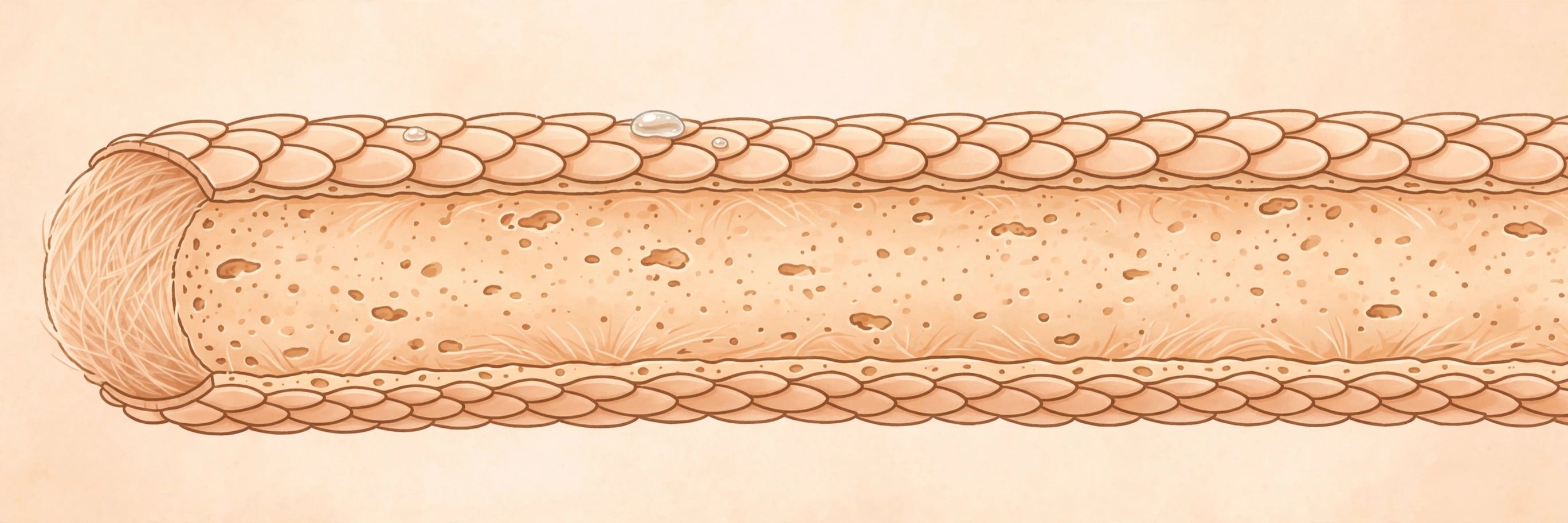
A hair strand is not a solid, impermeable rod. Its outer layer, the cuticle, consists of overlapping cells surrounding the cortex, which makes up most of the fiber. Water and some other substances can move into the fiber through multiple possible pathways involving the cuticle, the cell membrane complex, and less heavily keratinized regions of the hair (Gummer, Journal of Cosmetic Science, 2001).
In scientific terms, porosity refers more literally to voids, pores, cracks, and accessible spaces within this structure. Hessefort and colleagues used gas-sorption measurements to quantify pore volume, pore-size distribution, and surface area in human hair. Oxidative bleaching significantly altered these properties, demonstrating that chemical processing can change the physical porous structure of the fiber (Hessefort et al., Journal of Cosmetic Science, 2008).
So hair porosity is real. What is less established is the idea that everyone’s hair fits neatly into three consumer categories identifiable with a home test.
High-Porosity Hair Is Usually a Story About Damage
Hair can become more structurally porous as it is damaged, and bleaching is one of the clearest examples. Oxidative chemistry can disrupt cuticle structure and modify proteins and lipids within the fiber. Microscopy studies of heavily bleached hair have observed damaged or missing cuticle cells, fissures, and porous regions within the cortex.
A 2025 study examining textured hair under consumer-relevant washing, blow-drying, combing, and flat-ironing conditions also found changes in water permeability, surface topography, and other porosity-related properties, particularly when chemical and physical damage accumulated (Gasparin et al., Cosmetics, 2025).
This helps explain why heavily processed hair can behave differently when wet or conditioned. But there is an important complication: more porous does not automatically mean “better absorption” of every useful cosmetic ingredient. Penetration depends on the molecule.
Not Every Ingredient Penetrates Hair the Same Way
One of the best demonstrations comes from research on oils. Using secondary ion mass spectrometry, Ruetsch and colleagues found that coconut oil penetrated into human hair fibers, whereas mineral oil did not. The researchers proposed that coconut oil’s affinity for hair proteins contributed to the difference (Ruetsch et al., Journal of Cosmetic Science, 2001).
Later experiments also found differences among coconut, olive, and sunflower oils, reinforcing an important principle: two substances placed on the same hair fiber do not necessarily travel through it in the same way (Keis et al., Journal of Cosmetic Science, 2005).
Coconut oil has also been associated experimentally with reduced protein loss from hair compared with mineral and sunflower oils (Rele & Mohile, Journal of Cosmetic Science, 2003).
These are primarily hair-fiber laboratory studies, not clinical trials showing that one oil universally produces better-looking hair in people. Still, they demonstrate why “my hair is porous, therefore it absorbs this product” is an oversimplification. Molecular size, chemical structure, polarity, affinity for keratin, formulation, concentration, and contact time can all influence what happens.
And penetration is not always necessary. Many conditioning ingredients are valuable precisely because they remain largely on or near the hair surface, where they can reduce friction, improve combability, and change how the fiber feels.
Water Makes the Story Even More Complicated
Hair readily interacts with water. As water enters the fiber, hair swells and its protein structure becomes more mobile. Moisture-sorption research indicates that this behavior is governed by interactions between water and chemical sites within the keratin matrix — not simply by water filling empty “holes” like a sponge.
Interestingly, hair’s overall water-sorption behavior can remain surprisingly robust even after cosmetic treatment. That is another reason to be cautious with simple rules such as “high-porosity hair absorbs much more water.” Hair chemistry is more complicated than that.
What About the Famous Glass-of-Water Porosity Test?
There is little peer-reviewed evidence validating the popular test where a loose strand is dropped into water and classified according to whether it floats or sinks. That experiment has obvious confounding variables: surface oils, conditioner residue, styling products, surface tension, strand diameter, and whether the strand becomes completely wetted can all affect its behavior.
Laboratory scientists studying porosity instead use methods such as gas sorption, microscopy, swelling measurements, spectroscopy, and calorimetry. A floating strand should not be treated as a scientific diagnosis of “low-porosity hair.”
A more useful approach is simply to observe how your hair behaves. If it is heavily bleached, chemically processed, heat-damaged, rough, difficult to detangle, or prone to breakage, structural damage is likely more relevant to your product choices than whether a strand sinks in a cup.
What Porosity Means for Using a Hair Mask
For relatively undamaged hair, piling on more product or leaving a mask on indefinitely does not necessarily force more beneficial ingredients inside the shaft. Hair has physical and chemical limits on what can penetrate.
For damaged or highly processed hair, conditioning becomes especially useful because roughened surfaces and compromised cuticles can increase friction and tangling. A well-formulated mask can deposit conditioning materials on the fiber while certain compatible ingredients may also penetrate to varying degrees.
The goal should not necessarily be maximum absorption. It should be appropriate interaction with the hair fiber. Some ingredients work mainly on the surface. Some can penetrate. Some reduce friction. Some influence water movement. Some simply make hair feel smoother and easier to manage. Those are all legitimate cosmetic functions.
The Bottom Line
Hair porosity is real, but the internet version of porosity is much cleaner than the science. Hair fibers contain measurable pores and pathways, and chemical and physical damage can alter them. But “low,” “medium,” and “high” porosity are not universally standardized scientific hair types, and a simple float test cannot tell you which ingredients your hair will absorb.
Most importantly, a product does not have to penetrate deeply into the cortex to be useful. Surface conditioning and lubrication can be just as important to how hair looks, feels, and behaves.
For readers interested in incorporating copper peptides into their hair-care routine, the RootMira AHK-Cu Copper Peptide Hair Mask combines AHK-Cu with a conditioning mask format designed for use on the hair and scalp. The evidence around hair-fiber porosity should not be interpreted as proof that AHK-Cu penetrates every type of hair — or that greater penetration automatically means better cosmetic results — but it does reinforce why formulation matters as much as any single headline ingredient.
RootMira products are cosmetics, not medicines. This article shares general ingredient information, not medical advice.
RootMira's mask is built around AHK-Cu, the copper peptide for hair. See the mask →