Do Peptides Repair Split Ends? What the Research Actually Says About “Bond Repair” Claims
October 17, 2026
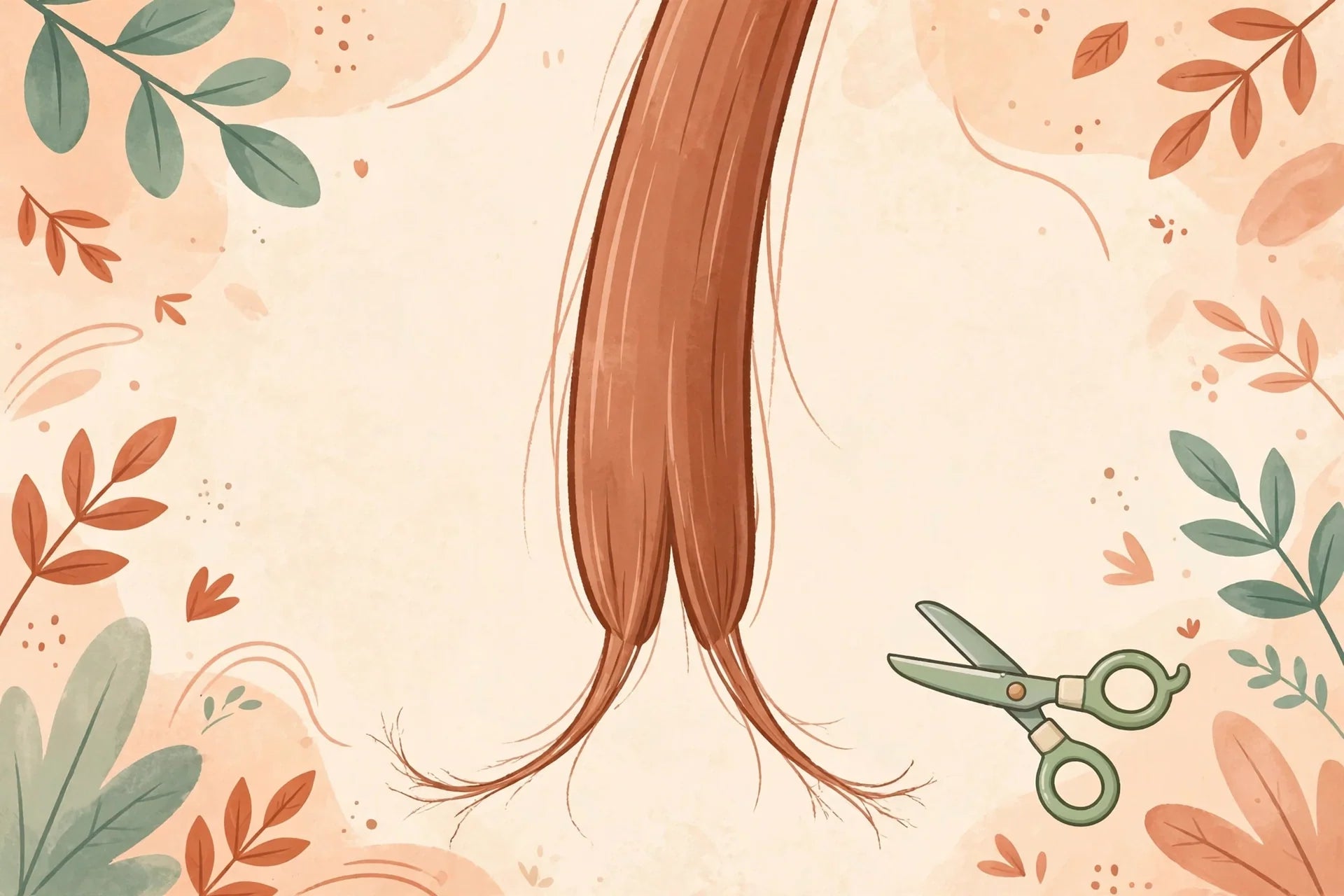
Split ends are one of those hair problems that cosmetic marketing makes sound surprisingly fixable. Products promise to “seal,” “mend,” “reconstruct,” or even “repair bonds” inside damaged hair. Add peptides to the formula, and the language can sound even more biological.
But a split hair fiber is not living tissue. Once it has physically divided, the science is much less glamorous: cosmetics can improve its surface, reduce friction, strengthen weakened fibers, and sometimes temporarily hold a split together. They cannot make a damaged hair shaft biologically heal itself.
What a Split End Actually Is
A true split end is called trichoptilosis. It develops when the protective cuticle at the end of a hair fiber becomes progressively worn away and the underlying cortex begins to separate longitudinally. Microscopy studies have directly documented this splitting of the terminal hair shaft (Pasricha & Jain, Indian Journal of Dermatology, Venereology and Leprology, 1989).
Hair ends are especially vulnerable because they are the oldest part of the fiber. Over months or years they accumulate brushing, combing, friction against clothing, washing, UV exposure, heat styling, coloring, bleaching, relaxing and other chemical processing.
Experimental brushing research has shown that repeated mechanical stress contributes to split-end formation and that chemically damaged hair is particularly vulnerable (Arai et al., Journal of the Society of Cosmetic Chemists of Japan, 1995). Hair-fiber researchers have also shown that bleaching increases breakage and that conditioning systems can reduce damage generated during repeated combing (Haake et al., Journal of Cosmetic Science, 2009).
Here is the critical point: hair outside the scalp is biologically dead keratinized material. It has no living repair system capable of rebuilding a cortex that has already split apart.
If the end has truly divided, the only permanent way to remove that split is to cut it off.
What “Split-End Mending” Actually Means
That does not mean split-end products do nothing.
Cosmetic scientists have developed polymers capable of temporarily drawing separated portions of a hair fiber back together. One published study used a combination of the cationic polymer Polyquaternium-28 and an anionic PVM/MA copolymer. The oppositely charged polymers formed a complex that deposited at damaged sites and temporarily held split fibers together (Rigoletto et al., Journal of Cosmetic Science, 2007).
The authors explicitly described the effect as “semi-permanent,” not permanent. The polymer system could survive some combing, but it ultimately rinsed away with shampoo.
That explains why split-end before-and-after photographs can look dramatic without showing true biological repair.
A conditioning film can smooth raised cuticle scales, reduce roughness, align the two branches of a split and make the end look almost whole under normal photography. Silicones, cationic polymers and other conditioning agents can also reduce friction between fibers, making hair easier to comb and helping prevent additional mechanical damage.
The appearance is real.
The reconstruction is not.
The “Bond Repair” Era
Hair contains several types of chemical interactions that help determine its strength and shape. Among the most important are disulfide bonds involving cysteine residues within keratin proteins.
Bleaching, permanent waving and other aggressive chemical processes can disrupt hair proteins and alter sulfur chemistry. This created the scientific foundation for the modern “bond-building” category.
A widely known salon technology introduced in the 2010s uses bis-aminopropyl diglycol dimaleate. Patents and subsequent cosmetic literature proposed that maleate chemistry could interact with reactive sulfur-containing groups in damaged keratin.
But the independent evidence is more nuanced than the marketing slogan “rebuilds broken bonds.”
Researchers studying bleached hair with infrared spectroscopy, Raman spectroscopy and scanning electron microscopy found that maleate-based treatments did interact with the hair fiber and produced visible improvements in cuticle morphology. However, they did not find an increase in disulfide-bond content in the cortex, and their results were not direct evidence that the proposed sulfur cross-linking reaction had occurred (Di Foggia et al., International Journal of Biological Macromolecules, 2021).
That distinction matters.
A treatment can improve the mechanical or cosmetic behavior of damaged hair without literally restoring the fiber to its original virgin structure.
Where Peptides Actually Fit
“Peptide” is also an unusually broad word in hair care.
Hydrolyzed keratin, for example, contains mixtures of protein fragments produced by breaking larger keratin proteins into smaller pieces. These are very different from short signaling peptides used in skin or scalp formulations.
There is genuine experimental evidence that certain hydrolyzed keratin peptides can interact with damaged hair fibers.
In a study of chemically relaxed textured hair, low-molecular-weight and medium-molecular-weight keratin fragments penetrated into the hair cortex, while much larger keratin fragments primarily deposited on the surface. Some peptide treatments also improved measured mechanical properties and reduced fiber breakage under laboratory conditions (Malinauskyte et al., International Journal of Cosmetic Science, 2021).
Other laboratory work with keratin hydrolysates has shown deposition around damaged cuticle regions along with improvements in measured hydration, softness and shine (Villa et al., BMC Biotechnology, 2013).
Researchers have also demonstrated that peptide characteristics such as cysteine content, hydrophobicity and charge influence how strongly peptides interact with hair keratin (Cruz et al., RSC Advances, 2017).
These are meaningful cosmetic effects.
But none of them demonstrate that a peptide permanently fuses the two halves of an existing split cortex back into one intact hair fiber.
Hydrolyzed Proteins Are Not the Same as Signal Peptides
This distinction is especially important when reading ingredient lists.
Hydrolyzed keratin or hydrolyzed wheat protein may contain many protein fragments capable of depositing on or, depending on size and hair condition, entering parts of the hair fiber.
A small cosmetic signal peptide is a defined sequence of only a few amino acids. Copper peptides such as AHK-Cu belong to this second category.
Evidence showing that hydrolyzed keratin fragments penetrate damaged hair therefore cannot automatically be transferred to every ingredient whose name contains the word “peptide.”
Different peptides have different molecular sizes, charges, sequences and chemical behavior.
What Peptides Cannot Do
Once the cortex has physically split, there is missing and fractured structural material. A cosmetic cannot recreate the original architecture of that fiber the way living tissue repairs a wound.
Peptides may deposit on damaged regions. Certain protein fragments may penetrate porous hair. Conditioning ingredients may lower friction. A formula may increase softness or improve resistance to mechanical breakage.
Those effects can make damaged hair behave better and can potentially slow the formation of new splits.
But “less breakage” and “repaired split ends” are not interchangeable claims.
That distinction is the entire story.
What We Can and Cannot Say
The evidence supports a practical way to think about hair repair.
Cosmetics can condition damaged hair, smooth the cuticle, reduce friction, temporarily bind a split together and improve some measurable mechanical properties. Certain hydrolyzed proteins and peptides can interact with or penetrate damaged fibers.
What the evidence does not establish is permanent restoration of a truly split hair shaft to its original undamaged structure.
No peptide should be described as biologically healing a split end.
For existing split ends, the definitive answer remains surprisingly low-tech: trim them.
For everything that has not split yet, prevention matters much more. Gentle detangling, reduced mechanical friction, sensible heat use, conditioning and protecting chemically processed lengths can decrease breakage. Keeping more fibers intact means retaining more of the length you already grew.
Where RootMira Fits
For readers interested in adding copper peptides to a conditioning routine, RootMira AHK-Cu Copper Peptide Hair Mask combines AHK-Cu with a rinse-off hair and scalp conditioning treatment. It should not be thought of as a split-end repair product. Its appropriate role is conditioning the hair and supporting a routine designed to reduce friction and everyday breakage while improving softness, manageability and feel.
RootMira products are cosmetics, not medicines. This article shares general ingredient information, not medical advice.
RootMira's mask is built around AHK-Cu, the copper peptide for hair. See the mask →