Do Peptides Cause Hair Shedding When You Start? The “Dread Shed” Question — What the Research Actually Says
October 11, 2026
The Short Answer: Peptides Are Not Minoxidil
You start using a new hair product. A week or two later, you notice more hair in the shower drain. You search online and encounter a reassuring explanation: it is just the “dread shed,” a temporary phase before your hair improves.
That explanation has a scientific basis for certain medications, particularly minoxidil. But applying the same reasoning to cosmetic peptides is a different matter.
There is currently no established clinical evidence that AHK-Cu, GHK-Cu, or other cosmetic hair-care peptides cause a predictable initial shedding phase.
That does not prove these ingredients can never contribute to shedding. It means the specific claim that peptide-induced shedding is a normal, beneficial adjustment period has not been demonstrated in adequately controlled human research.
Understanding the difference starts with how hair naturally grows and sheds.
How the Hair Growth Cycle Actually Works
Each hair follicle operates on its own biological schedule. Unlike animals that shed much of their coat seasonally, human scalp follicles generally cycle independently.
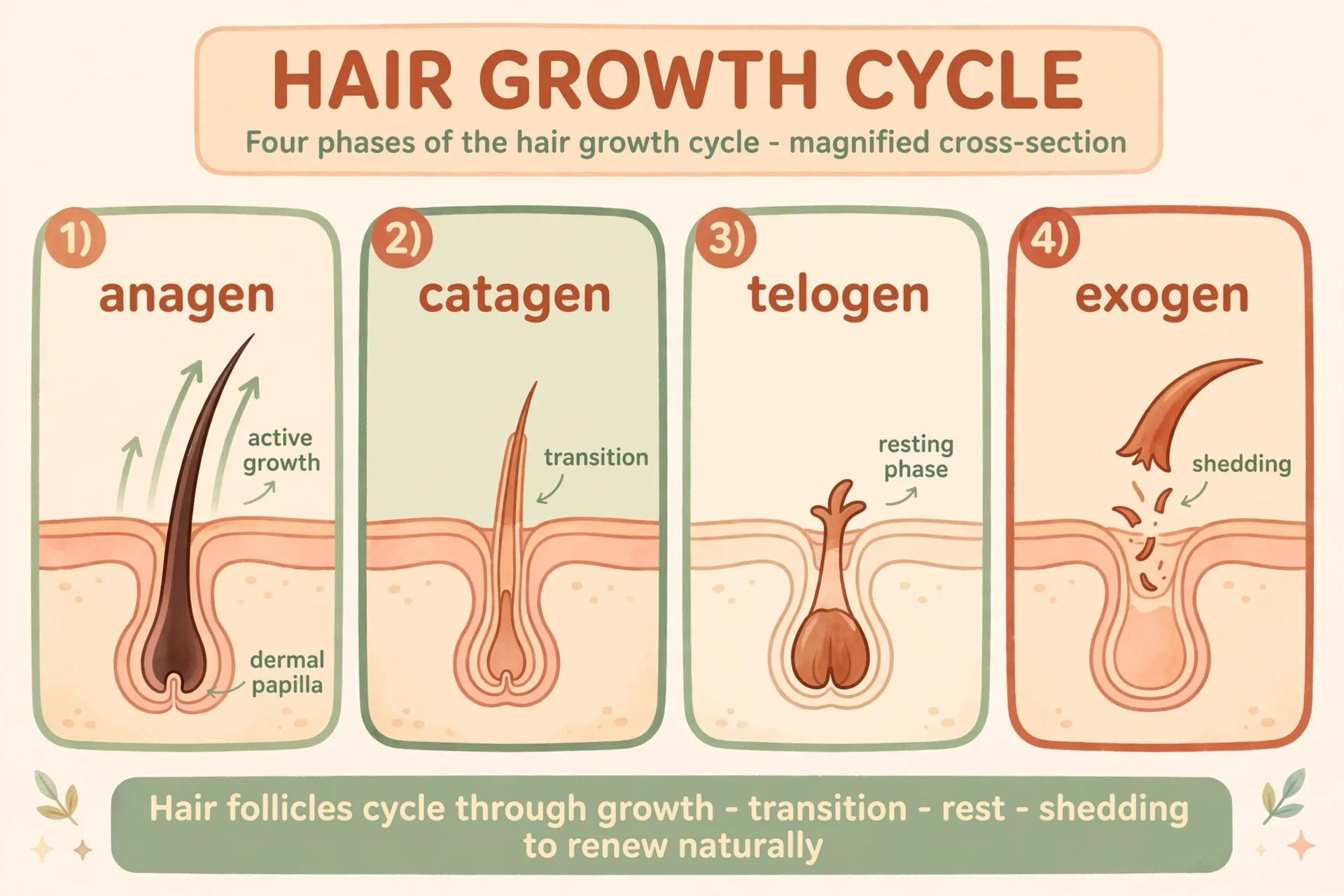
The cycle has four commonly described stages:
- Anagen (growth): The follicle actively produces a hair fiber. On the scalp, this phase can last several years.
- Catagen (transition): Active growth stops, and the follicle undergoes a short period of structural regression.
- Telogen (resting): The follicle remains relatively inactive while the mature hair is retained.
- Exogen (release): The old hair is shed, sometimes as a new hair begins developing within the follicle.
Exogen overlaps with other stages rather than functioning as an entirely separate, sequential growth phase. Researchers distinguish the release of a hair fiber from the follicle’s broader growth-cycle transitions (Stenn & Paus, Physiological Reviews, 2001; Higgins et al., Journal of Investigative Dermatology, 2009).
According to the American Academy of Dermatology, shedding approximately 50–100 hairs daily is normal.
The number visible in your shower is not necessarily the number shed that day. Washing frequency, brushing habits, hair length, and how loose hairs accumulate all influence what you notice.
This distinction matters because seeing more hair does not automatically mean a product has altered follicle biology.
Why Minoxidil Can Cause an Initial Shed
Minoxidil is a medication with documented effects on hair-follicle cycling. Its early shedding phenomenon is one reason the term “dread shed” became familiar in hair-care discussions.
In the hair-cycle model proposed by researcher Ralf Paus and colleagues and developed in clinical discussions by Rebora and others, some treatments can accelerate the release of resting hairs.
Minoxidil-associated shedding is commonly explained through shortened telogen duration and earlier release of existing club hairs as follicles transition toward anagen. This has been described as immediate telogen release (Headington, Archives of Dermatology, 1993; Messenger & Rundegren, British Journal of Dermatology, 2004).
A club hair is an older hair fiber with a characteristic keratinized root. When released, it is not necessarily evidence that the follicle has been permanently damaged.
U.S. labeling for topical minoxidil products also warns that hair loss may temporarily increase or continue for up to approximately two weeks after treatment begins.
Importantly, the label’s early warning period and the longer shedding patterns described in some clinical observations are not identical measurements. Individual experiences can differ.
The critical point is that minoxidil has its own pharmacological mechanisms and clinical evidence.
A mechanism documented for a medication cannot automatically be assigned to a cosmetic ingredient simply because both are marketed for scalp care.
What Does the Research Say About Copper Peptides?
Copper peptides are molecules in which short chains of amino acids interact with copper ions.
Two examples frequently discussed in hair-care formulations are:
- AHK-Cu: a copper complex involving the tripeptide alanine-histidine-lysine.
- GHK-Cu: a copper complex involving the tripeptide glycine-histidine-lysine.
Although their names look similar, they are chemically distinct compounds. Evidence involving one should not automatically be attributed to the other.
One frequently cited investigation examined AHK-Cu using human hair follicles maintained in laboratory culture and dermal papilla cells. The researchers reported effects on follicle elongation and cellular activity under experimental conditions (Pyo et al., Archives of Pharmacal Research, 2007).
That is interesting early-stage research, but it is not a clinical trial demonstrating what happens when consumers apply an AHK-Cu cosmetic product to their scalps.
A follicle growing in a controlled laboratory environment does not experience the full complexity of a living person’s scalp, including normal product use, washing, skin-barrier function, and exposure to an entire cosmetic formula.
The study also did not establish an initial shedding period.
The same evidence limitation applies to other cosmetic peptides marketed for hair care, including biotinoyl tripeptide-1, acetyl tetrapeptide-3, and palmitoyl tripeptide-1.
No adequately controlled, published human trial has established a predictable early-shedding phase caused by these cosmetic peptides, and reliable peptide-specific shed-count data are lacking.
This is absence of evidence within a limited research base, not proof that shedding is impossible.
It also means that telling consumers increased shedding is a sign that a peptide is working would go beyond the available science.
What Else Might Explain Shedding After a New Product?
Timing alone cannot establish causation. Several other explanations deserve consideration.
- Telogen effluvium and delayed triggers. Physical or emotional stress, significant illness, childbirth, nutritional deficiencies, and certain medications can disrupt normal hair cycling. Increased shedding may become noticeable two to four months after the triggering event, making a newly introduced cosmetic product an easy but potentially misleading suspect (Malkud, Journal of Clinical and Diagnostic Research, 2015). Iron deficiency is an established consideration in shedding evaluations. Vitamin D deficiency has also been investigated, although its causal relationship with shedding is less certain.
- Irritation from the complete formula. A product contains much more than its headline peptide. Fragrance compounds, preservatives, cleansing surfactants, and high concentrations of alcohol can irritate sensitive scalps. Itching, redness, burning, or flaking after application may suggest irritation or contact dermatitis rather than a beneficial hair-cycle adjustment.
- Mechanical stress and breakage. New routines sometimes introduce vigorous scalp massage, aggressive brushing, tight hairstyles, or repeated manipulation of wet hair. These habits can increase breakage or dislodge hairs already ready to shed. Short broken fibers are not equivalent to complete hairs released naturally from follicles.
- Seasonal and washing-related variation. Hair shedding can fluctuate throughout the year, although seasonal patterns vary between individuals. Research has described seasonal changes in telogen activity (Rebora, Clinical, Cosmetic and Investigational Dermatology, 2019). Similarly, someone who washes twice weekly may notice more accumulated hairs per wash than someone washing daily.
None of these explanations should be assumed automatically. They simply demonstrate why a change in shedding requires more context than the introduction date of one ingredient.
When Should You See a Dermatologist?
An occasional increase in visible hairs is not necessarily concerning. However, sudden substantial shedding across the scalp, distinct patches of missing hair, or shedding that persists beyond a couple of months deserves professional evaluation.
A dermatologist may assess possibilities such as telogen effluvium, alopecia areata, thyroid abnormalities, iron deficiency, or medication-related changes.
Scalp pain, marked inflammation, or rapidly progressing changes are additional reasons to seek evaluation sooner.
Cosmetic products should not be presented as substitutes for that evaluation.
The Bottom Line: Don’t Assume Shedding Means a Peptide Is Working
Minoxidil-associated early shedding has a documented pharmacological explanation and published human evidence. In a 2025 retrospective study, 49 participants using topical minoxidil were followed for 24 weeks. Shedding increased around week four, generally declined by week 12, and greater early shedding was associated with better measured outcomes at week 24. Because this was an observational study, the association should not be interpreted as a guarantee of improvement for any individual (2025, Journal of Dermatological Treatment).
Cosmetic peptides do not have comparable evidence establishing a predictable early-shedding phase.
For readers interested in exploring copper peptides as part of a hair-care routine, the RootMira AHK-Cu Copper Peptide Hair Mask offers a cosmetic formulation featuring AHK-Cu alongside conditioning ingredients intended to help hair feel softer, smoother, and more manageable. Its inclusion of AHK-Cu should not be interpreted as proof of clinically demonstrated effects on shedding or follicle cycling.
RootMira products are cosmetics, not medicines. This article shares general ingredient information, not medical advice.
RootMira's mask is built around AHK-Cu, the copper peptide for hair. See the mask →