Biotinoyl Tripeptide-1: The "Hair Peptide" in Growth Serums — What the Research Actually Shows
October 4, 2026
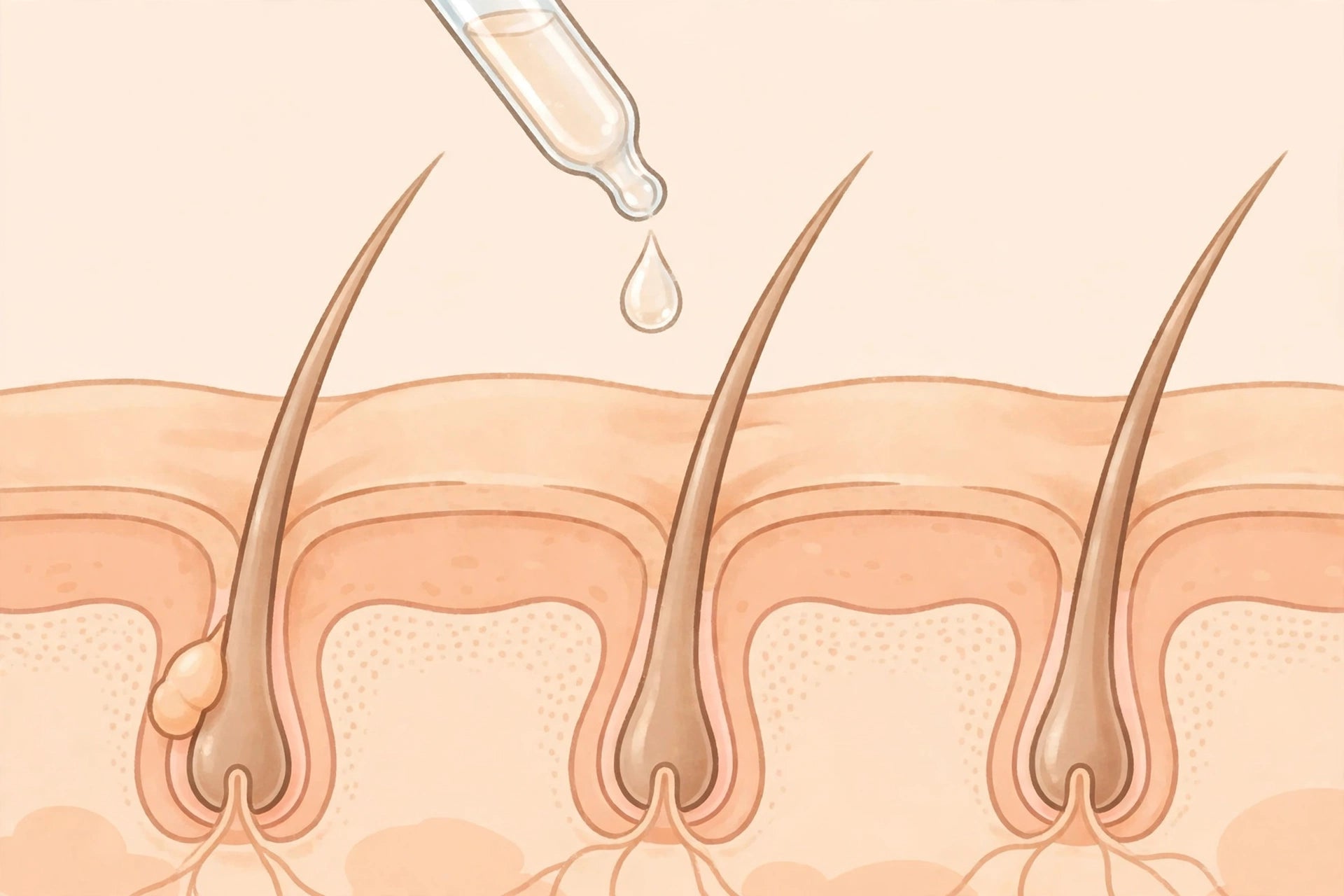
Biotinoyl tripeptide-1 appears on ingredient lists for scalp serums, brow treatments, lash products, and formulas marketed around thicker- or fuller-looking hair. The name sounds highly technical, and product descriptions often give the impression that the ingredient has an extensive clinical record.
The published research tells a more cautious story. Biotinoyl tripeptide-1 is scientifically interesting, and there is some emerging evidence involving formulations that contain it. But direct human evidence showing what biotinoyl tripeptide-1 does by itself is extremely limited.
What Exactly Is Biotinoyl Tripeptide-1?
Biotinoyl tripeptide-1 is also called biotinyl-GHK or biotin-GHK. Chemically, it combines biotin with the three-amino-acid peptide Gly-His-Lys, better known as GHK.
That makes it related to other GHK-based cosmetic peptides, but it is not the same molecule as copper tripeptide-1, or GHK-Cu. Biotinoyl tripeptide-1 contains a biotin group attached to GHK; it is not inherently a copper peptide.
The molecule has a molecular weight of roughly 567 daltons. It is used primarily as a cosmetic conditioning and scalp-care ingredient rather than as a pharmaceutical active.
Its association with hair largely comes from its inclusion in ingredient complexes such as Procapil, which combines biotinyl-GHK with apigenin and oleanolic acid. And that combination issue becomes extremely important when interpreting the research.
The Theory: Why Put a GHK-Based Peptide in a Hair Serum?
One proposed idea is that biotinyl-GHK may influence the environment surrounding the follicle and extracellular matrix. GHK belongs to a class of small peptides sometimes discussed as “matrikines” — signaling fragments derived from extracellular-matrix proteins that can influence cellular behavior. Research on matrikines more broadly has shown that extracellular-matrix-derived peptides can participate in cell signaling (Maquart et al., Journal de la Société de Biologie, 1999).
But that general biology does not automatically prove that topical biotinoyl tripeptide-1 increases human hair growth. That leap — from a plausible mechanism to a clinically demonstrated outcome — is where cosmetic marketing frequently moves faster than the evidence.
What Do Human Studies Actually Show?
One useful clinical study was published by Samadi and colleagues in the Journal of Cosmetic Dermatology in 2024. Nineteen men completed a 12-week study using a topical formula containing 3% Procapil along with caffeine and zinc PCA. Researchers reported a statistically significant reduction in hair collected during a combing test and an improvement in the terminal-to-vellus hair ratio. However, total hair count and hair density did not change significantly, and the anagen-to-telogen ratio also showed no statistically significant improvement (Samadi et al., Journal of Cosmetic Dermatology, 2024).
Most importantly, this was not a trial of biotinoyl tripeptide-1 alone. The product contained caffeine, zinc PCA, and the entire Procapil complex, which itself contains apigenin and oleanolic acid in addition to biotinyl-GHK. It was also a small, single-group before-and-after study rather than a placebo-controlled trial. So it cannot tell us how much — if any — of the observed effect came specifically from biotinoyl tripeptide-1.
A More Recent 40-Person Study
A 2025 study by Wu and colleagues evaluated Biosea Revive Serum in 40 adults over 90 days (Wu et al., Cosmetics, 2025). This study is particularly interesting because biotinoyl tripeptide-1 was specifically included among the serum’s featured ingredients.
Researchers also performed laboratory experiments using human hair dermal papilla cells. The complete serum increased cell proliferation and reduced reactive oxygen species and 5-alpha-reductase protein expression under the study conditions.
That sounds impressive — but again, the distinction matters. The researchers tested the finished serum, not isolated biotinoyl tripeptide-1. The formula contained numerous additional ingredients, including Phyllanthus emblica extract, acetyl tetrapeptide-3, red clover extract, panthenol, Wasabia japonica extract, algae-derived ingredients, and other components. The human portion was also open-label rather than placebo-controlled.
So the study provides early evidence for that particular multi-ingredient formulation. It does not demonstrate that biotinoyl tripeptide-1 alone produced the changes. And the laboratory results should be described exactly for what they are: early-stage mechanistic findings, promising but not proof of the same effect in people.
What About Lashes and Brows?
Biotinoyl tripeptide-1 is now common in lash and brow serums, yet peer-reviewed clinical evidence isolating the peptide for these uses appears especially sparse. Supplier studies are sometimes cited in cosmetic marketing, but these are different from independently published, peer-reviewed clinical trials.
Likewise, when a finished lash serum contains biotinoyl tripeptide-1 alongside several peptides, botanical extracts, or other actives, improvements in lash appearance cannot automatically be attributed to this one ingredient. For now, claims implying that biotinoyl tripeptide-1 itself has been clinically proven to dramatically increase lash, brow, or scalp-hair growth go beyond what the published evidence can establish.
An Interesting New Direction: The Hair Fiber Itself
There is another area of research that has little to do with follicle growth. In 2026, Toksoy and colleagues studied biotinoyl tripeptide-1 encapsulated inside solid lipid nanoparticles and applied the formulation to hair fibers exposed repeatedly to 200°C heat. Using scanning electron microscopy and thermal analysis, the researchers reported better preservation of cuticle structure and improved resistance to thermal damage compared with heat-treated controls (Toksoy et al., Journal of Health Sciences and Medicine, 2026).
This was a laboratory hair-fiber experiment — not a human scalp-growth trial — and the peptide was delivered through a specialized lipid nanoparticle system. Still, it raises an interesting possibility: biotinoyl tripeptide-1 may eventually prove useful not only in scalp formulations but also in products designed to protect the physical hair fiber.
The Bottom Line
Biotinoyl tripeptide-1 is a legitimate cosmetic peptide, not a fictional marketing ingredient. But its reputation as a clinically established “hair-growth peptide” is ahead of the evidence. Published studies involving formulations that contain it provide some encouraging signals. What is still missing are large, well-controlled human trials testing biotinoyl tripeptide-1 by itself at clearly defined concentrations.
Until those studies exist, the scientifically accurate position is straightforward: biotinoyl tripeptide-1 is promising, but its individual contribution to fuller-looking scalp hair, lashes, or brows remains uncertain.
For readers interested specifically in copper peptides rather than biotinoyl tripeptide-1, the RootMira AHK-Cu Copper Peptide Hair Mask combines AHK-Cu with a conditioning hair-mask format designed for hair and scalp care. As with other cosmetic peptides, it is best approached as part of a consistent cosmetic routine rather than as a medical treatment.
RootMira products are cosmetics, not medicines. This article shares general ingredient information, not medical advice.
RootMira's mask is built around AHK-Cu, the copper peptide for hair. See the mask →