Argan Oil for Hair: What the Research Actually Says About the “Liquid Gold” Claim
November 3, 2026
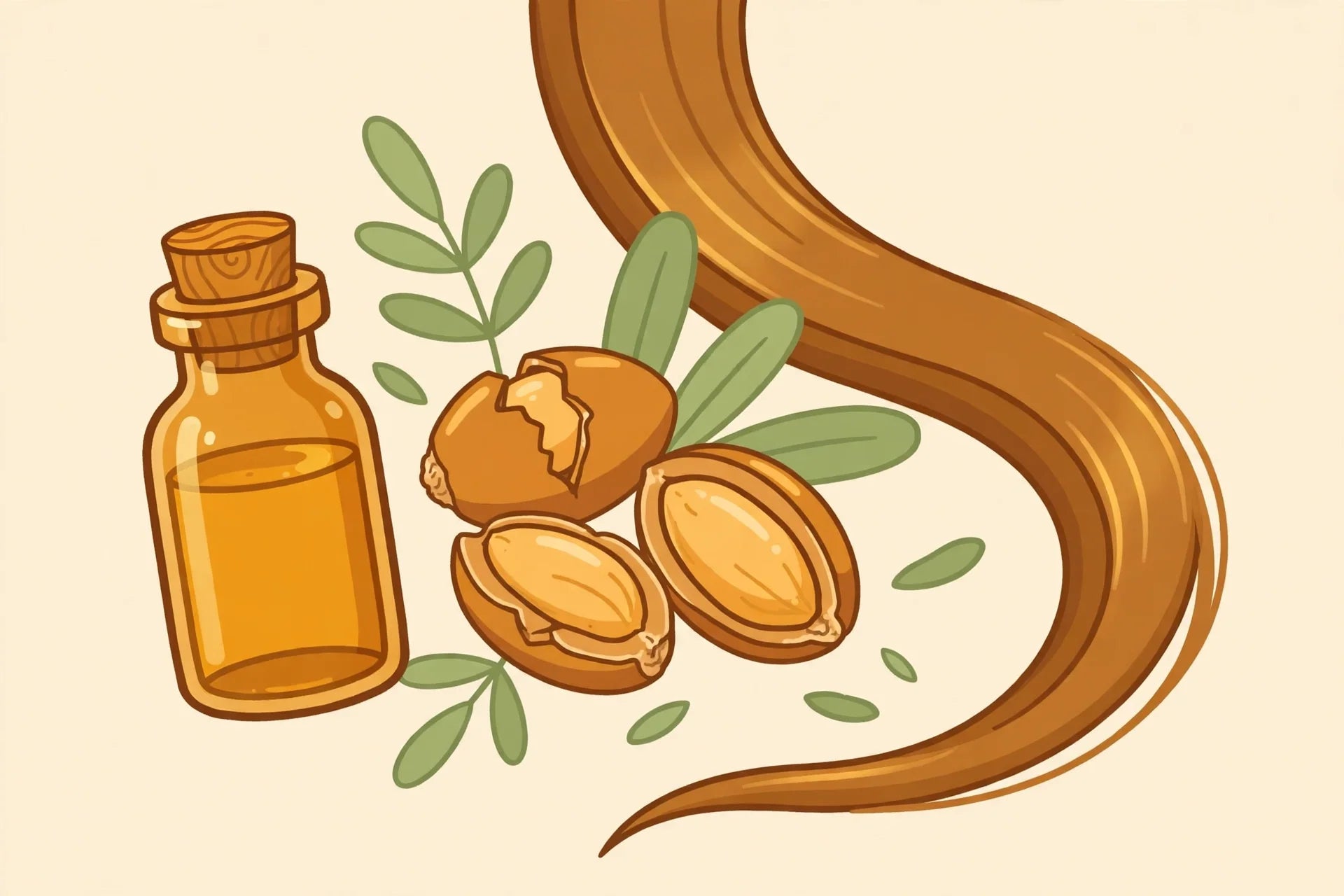
Argan oil has earned an extraordinary reputation in hair care. Nicknamed “liquid gold,” this Moroccan botanical oil appears in everything from luxury serums to conditioners promising stronger, shinier, healthier-looking hair.
But does the science justify its reputation?
Published research suggests argan oil has useful cosmetic properties, including potential protection against certain forms of hair-fibre damage. However, claims about hair growth, permanent repair, and dramatic transformation go considerably further than the available evidence.
Understanding the difference starts with the chemistry.
What Is Argan Oil?
Argan oil is extracted from the kernels of Argania spinosa, a tree native to Morocco.
Its composition explains much of its cosmetic appeal.
According to a comprehensive chemical review, argan oil contains approximately 43–49% oleic acid and 29–37% linoleic acid, alongside smaller quantities of saturated fatty acids (Gharby and Charrouf, Frontiers in Nutrition, 2022).
It also contains tocopherols, including vitamin E compounds, and plant sterols.
These ingredients have different functions.
Oleic and linoleic acids are components of triglycerides that contribute to the oil’s spreading and conditioning characteristics. On hair, deposited oils can provide lubrication and alter how individual fibres interact.
Tocopherols have antioxidant properties, but antioxidant activity measured in laboratory systems does not automatically demonstrate protection inside human hair.
Plant sterols contribute to the oil’s chemical profile, although their specific effects on hair remain insufficiently established.
In other words, argan oil has an interesting composition. That does not make every claim about it scientifically proven.
What Do Hair-Fibre Studies Actually Show?
One particularly relevant investigation examined argan oil as a pretreatment before chemically induced oxidative damage.
Researchers treated excised human hair with argan oil, exposed it to an oxidising agent, and evaluated changes using attenuated total reflectance (ATR) infrared spectroscopy and protein-loss measurements.
The study reported protective effects associated with argan-oil pretreatment (Sharifi et al., Journal of Cosmetic Dermatology, 2022).
This is meaningful evidence, but the distinction matters: researchers examined hair fibres outside the body under controlled experimental conditions.
They did not demonstrate that regularly applying an argan-oil serum permanently restores damaged hair on someone’s head.
Another investigation compared coconut, avocado, and argan oils using Raman spectroscopy and mechanical testing.
Researchers examined oil interactions with untreated and bleached hair fibres. Their findings suggested that previous hair damage influenced oil penetration and that bleached fibres showed greater affinity for argan oil (Cosmetics, 2024, 11(2), 64).
That finding cuts both ways, though: the same study found that the greater affinity came with increased water uptake and greater fragility to mechanical stress in the bleached fibres, so deeper penetration did not mean stronger hair.
This challenges the simplistic claim that argan oil only sits on the surface.
Some interaction with the fibre interior may occur under particular conditions.
However, penetration does not automatically mean repair.
What About Friction, Combing, and Shine?
Hair oils can reduce friction by lubricating fibres and changing their surface characteristics.
In principle, easier fibre movement may improve combing and reduce mechanical stress. Research into hair breakage confirms that snagging and impact forces during combing contribute to fibre damage (Robbins, Journal of Cosmetic Science, 2006).
A smoother surface can also reflect light more uniformly, creating the appearance of shine.
These are reasonable cosmetic mechanisms, but the available argan-specific studies do not establish universally reproducible improvements in combing force, shine, or moisture retention across all hair types.
Nor do they establish how those effects persist over months of everyday use.
That distinction separates a plausible conditioning benefit from a clinically demonstrated outcome.
Argan Oil Versus Coconut Oil, Shea Butter, and Jojoba
Not all botanical oils behave identically.
Coconut oil contains substantial amounts of lauric-acid triglycerides. A frequently cited investigation found that coconut oil reduced protein loss from damaged and undamaged hair under the tested conditions (Rele and Mohile, Journal of Cosmetic Science, 2003).
Its molecular structure helps explain why coconut oil can penetrate hair fibres.
Argan oil has a different fatty-acid composition, so identical behaviour should not be assumed.
Shea butter is a semisolid botanical fat commonly used to provide richer conditioning and lubrication. It may suit hair that benefits from heavier products, although excessive application can leave fine hair feeling coated.
Jojoba oil is chemically different again. It consists predominantly of liquid wax esters rather than the triglycerides characteristic of argan and coconut oils.
These differences influence formulation properties, texture, spreading, and sensory feel.
For fine hair, a small amount of argan-containing leave-in product may provide a more acceptable finish than a heavily applied butter.
Coarse, curly, or textured hair may accommodate richer formulations, particularly on dry-feeling lengths and ends.
However, hair type alone does not determine the ideal product. Porosity, previous chemical processing, formulation, and application quantity all matter.
Too much oil can produce greasiness, reduce volume, and contribute to residue accumulation.
“A little goes a long way” is therefore practical formulation advice, not merely marketing language.
The Skin-Evidence Trap
Argan oil has also been investigated in human skin studies.
In one study involving 60 postmenopausal women, researchers observed improvements in skin hydration measurements following dietary and topical argan-oil interventions (Boucetta et al., Przegląd Menopauzalny, 2014).
A related investigation reported improvements in measured skin elasticity (Boucetta et al., Clinical Interventions in Aging, 2015).
These studies are relevant to skin cosmetics.
However, they examined forearm skin, not hair-fibre strength, follicle activity, or hair density. The interventions also involved both dietary and topical exposures.
Living skin and the visible hair shaft are fundamentally different biological materials.
Skin contains living cells and maintains an active barrier. Visible hair consists primarily of keratinised material without living cellular repair mechanisms.
Consequently, skin hydration findings cannot establish that argan oil moisturises hair in the same biological sense.
Nor do skin-elasticity measurements demonstrate improvements in hair elasticity.
Does Argan Oil Promote Growth or Repair Damage?
This is where marketing frequently exceeds the evidence.
The studies discussed above do not establish that argan oil increases hair density, changes the hair-growth cycle, or produces additional growth.
There is also no convincing published human clinical trial demonstrating these outcomes from cosmetic argan-oil application.
Similarly, argan oil cannot permanently reconnect a split hair end.
Oil may temporarily improve the appearance of frayed or rough sections, but the underlying structural separation remains.
The distinction between preventing some additional damage and reversing existing damage is especially important.
The 2022 oxidative-damage study investigated pretreatment before an experimental damaging procedure.
That is not evidence that argan oil reconstructs fibres already damaged by repeated bleaching, heat, or mechanical stress.
Likewise, the presence of vitamin E does not establish that antioxidants have reached the relevant structures inside hair at protective concentrations.
Claims about scalp benefits require their own evidence. Findings on forearm skin cannot establish improvements in scalp condition or follicle function.
How Much Argan Oil Should You Use?
There is no scientifically established universal dose of argan oil for hair.
Published laboratory concentrations cannot automatically be translated into recommendations for finished consumer products.
A pure oil, a leave-in serum, and a rinse-off mask may deposit very different amounts of oil.
Contact time, emulsifiers, other conditioning ingredients, and washing conditions all affect performance.
For practical cosmetic use, applying a small quantity to the mid-lengths and ends is a reasonable starting point.
Additional product can be used according to hair length, density, and individual preference.
Any deposited oil gradually diminishes through washing, friction, and routine grooming.
Consequently, conditioning benefits require maintenance rather than representing permanent structural changes.
Is Argan Oil Safe for Hair?
Argan oil is generally well tolerated in cosmetic formulations at typical use levels, although irritation or sensitivity can occur.
People with sensitive skin may prefer to patch-test a new product before broader application.
Argan oil comes from the kernels of a tree. Anyone with a known tree-nut allergy should consult their clinician before using an argan-containing product rather than assuming it is suitable.
Individual reactions can also involve fragrances, preservatives, or other ingredients in a finished formulation.
The Verdict: Useful Conditioner, Not Liquid Magic
Argan oil deserves a place in cosmetic hair care, but its strengths should be described accurately.
Its lipid composition provides a credible basis for lubrication, softness, smoother-looking hair, and improved manageability.
Controlled hair-fibre research also suggests potentially useful effects under specific experimental conditions, particularly before oxidative damage.
What remains missing is substantial long-term clinical evidence demonstrating consistent outcomes across different hair types, routines, and finished formulations.
Argan oil can help hair look and feel better.
That is a worthwhile cosmetic benefit without promising permanent reconstruction or biological transformation.
For readers interested in exploring a different ingredient approach, the RootMira AHK-Cu Copper Peptide Hair Mask combines AHK-Cu copper peptides with conditioning ingredients including shea butter, coconut oil, castor oil, rosemary, and aloe. It offers a cosmetic option for scalp hydration, softness, manageability, and natural-looking shine, without implying that peptide inclusion establishes clinically proven hair-growth effects.
RootMira products are cosmetics, not medicines. This article shares general ingredient information, not medical advice.
RootMira's mask is built around AHK-Cu, the copper peptide for hair. See the mask →