Aloe Vera for Hair: What the Research Actually Says About the “Soothing Growth” Plant
November 3, 2026
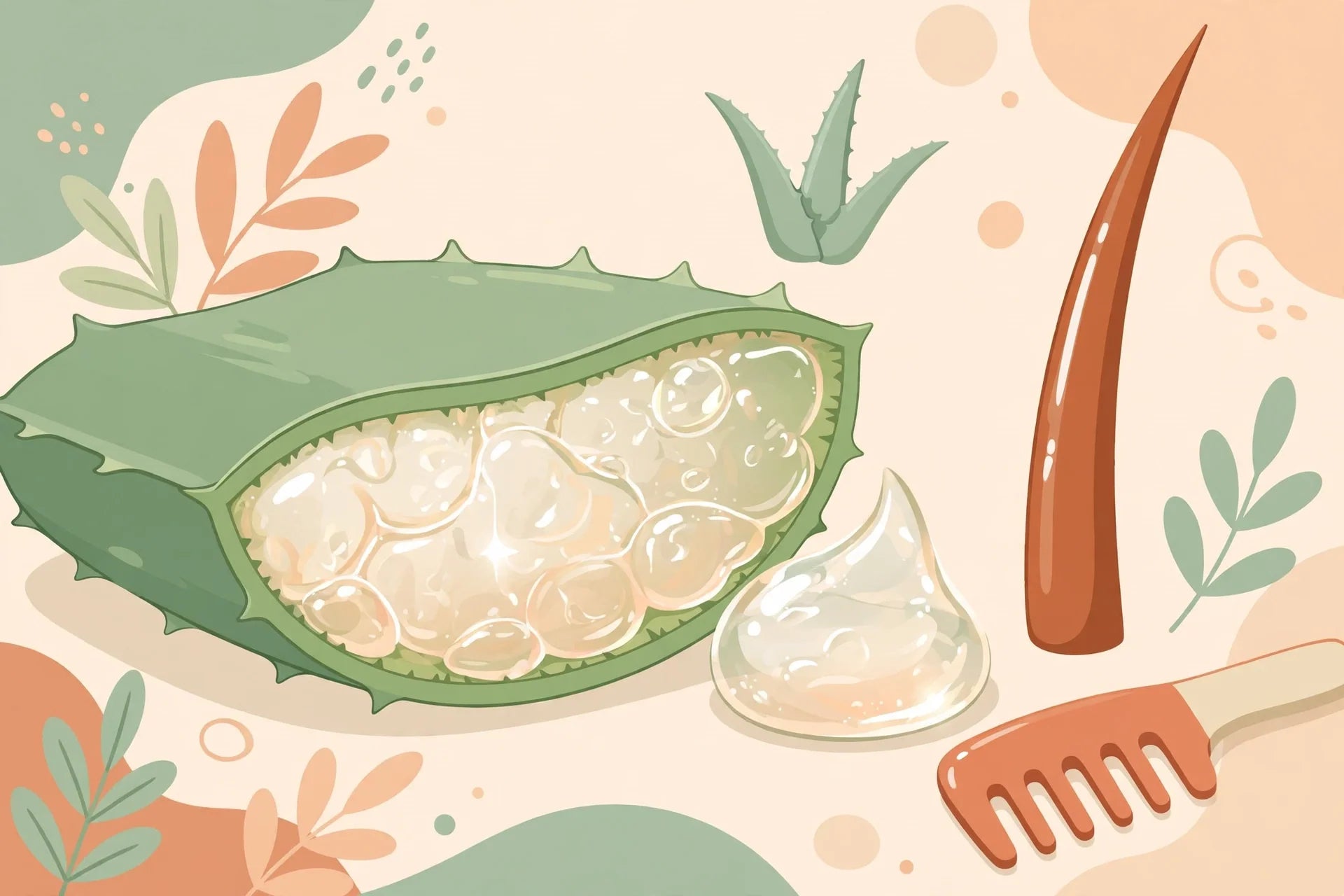
Aloe vera has been a staple of traditional beauty routines for centuries. Today it appears in shampoos, conditioners, scalp serums, and hair masks — often accompanied by promises of healthier follicles, faster hair growth, and a perfectly balanced scalp.
But how much of this reputation is supported by scientific research? The answer is more nuanced than most ingredient marketing suggests. Aloe vera has legitimate moisturising potential, supported by small human skin studies. Its effects on scalp comfort are plausible, although direct evidence remains limited. Claims that it stimulates hair growth or clears blocked follicles, however, go considerably beyond what human research has established.
Understanding the difference begins with the plant itself.
What Is Actually Inside Aloe Vera?
Aloe vera, botanically known as Aloe barbadensis Miller, is a succulent whose thick leaves contain several chemically distinct materials. The clear inner-leaf gel consists of about 99.5% water, with the remaining fraction containing polysaccharides, amino acids, enzymes, minerals, and small quantities of vitamins. Among its most studied constituents is acemannan, an acetylated polysaccharide composed primarily of sugar units. Acemannan and related carbohydrates contribute to the gel’s distinctive texture and have attracted scientific interest because of their biological activity in laboratory experiments.
However, the leaf’s inner gel should not be confused with its yellow latex. The latex, found near the outer rind, contains anthraquinone compounds, including aloin. Historically associated with laxative preparations, these compounds have a different chemical and safety profile from purified inner-leaf gel. Whole-leaf extracts may contain components from both regions unless specifically processed to remove unwanted compounds.
Commercial cosmetic ingredients also undergo extraction, filtration, preservation, or drying. Consequently, a standardised aloe extract in a hair mask is not chemically identical to freshly extracted gel. These distinctions matter when interpreting research (Hamman, Molecules, 2008).
Does Aloe Vera Actually Moisturise the Scalp?
Moisturisation is among aloe vera’s more scientifically defensible cosmetic benefits. In a human study, Dal’Belo and colleagues examined formulations containing 0.10%, 0.25%, and 0.50% freeze-dried aloe extract. Twenty women applied the formulations to their forearms, and researchers measured skin hydration and transepidermal water loss.
After a single application, formulations containing 0.25% or 0.50% aloe increased hydration compared with the base formulation. After two weeks, all three aloe concentrations improved measured hydration. Importantly, transepidermal water loss did not significantly improve relative to the formulation without aloe.
This distinction matters. Increased water content in the skin’s outermost layer does not automatically demonstrate restoration or strengthening of its protective barrier. The researchers suggested that aloe could support hydration through a humectant mechanism: attracting or retaining moisture in the skin’s outer layers (Dal’Belo et al., Skin Research and Technology, 2006).
However, the experiment examined forearm skin, not the scalp. Although both contain similar fundamental skin structures, scalp conditions differ because of hair density, sebum production, and the surrounding microbial environment. The study therefore supports aloe’s potential as a moisturising cosmetic ingredient — not a proven scalp-specific result.
Why Aloe Vera Is Associated With Soothing
Aloe’s reputation for soothing skin partly reflects centuries of traditional use. Researchers have also investigated aloe polysaccharides and other constituents in laboratory models involving cellular signalling and responses to environmental stress. These experiments provide possible biological explanations for aloe’s longstanding reputation.
However, a cellular response observed in controlled laboratory conditions cannot establish that a cosmetic hair product produces the same outcome on a human scalp. Concentration, ingredient processing, exposure time, and the surrounding formulation can all change how a compound behaves. Reviews discussing aloe’s biological properties acknowledge these differences between experimental mechanisms and established human benefits (Surjushe et al., Indian Journal of Dermatology, 2008).
From a cosmetic perspective, aloe-containing products may contribute to a hydrated, comfortable-feeling scalp. That is a more defensible description than promising biological changes that have not been demonstrated in appropriate human trials.
Do Aloe’s Enzymes Remove Dead Skin and Unclog Follicles?
One frequently repeated internet claim is that aloe vera contains proteolytic enzymes that dissolve dead skin cells and clear blocked hair follicles. Proteolytic enzymes are substances capable of breaking apart proteins, and aloe preparations can contain enzymes, including proteases. However, the presence of enzymes in a plant does not establish that they remain active after cosmetic processing or perform a specific function when applied to skin. Enzyme activity depends on factors including concentration, temperature, pH, stability, and contact time.
Crucially, published human scalp research has not established that ordinary aloe-containing cosmetic formulations enzymatically remove accumulated dead skin or clear hair follicles. The claim appears to rely largely on extrapolating general biochemical properties into an unverified scalp benefit. An ingredient containing enzymes is not the same as a clinically demonstrated exfoliating product.
Can Aloe Vera Make Hair Grow Faster or Thicker?
This is where the gap between popularity and scientific evidence becomes especially significant. Laboratory investigations and preliminary animal research involving aloe-derived preparations are sometimes cited as evidence of hair-growth potential. Such studies can be useful for generating hypotheses about biological mechanisms — but an animal experiment does not establish equivalent effects in humans. Hair follicles differ between species, and experimental extracts may contain substantially different concentrations of active substances from those found in commercial hair products. In addition, a response observed in isolated cells cannot demonstrate improved hair growth in a living person.
No large, well-controlled randomised human trial has established that aloe vera alone increases hair growth rate or hair density. The available evidence also does not establish an effective cosmetic concentration, application frequency, or duration for producing those outcomes.
This does not prove that aloe has no possible biological effects. It means the necessary human evidence is insufficient to support the advertised hair-growth claims. For consumers, the distinction between improving how hair looks and feels and changing how follicles produce hair is essential: a conditioning product may make existing strands softer, smoother, and easier to manage without altering biological hair growth.
What About Dandruff and Scalp Flaking?
A frequently cited human study was published by Vardy and colleagues in 1999. This randomised, double-blind, placebo-controlled investigation evaluated an aloe vera crude-extract emulsion in 44 adults with seborrheic dermatitis. Researchers assessed several clinical symptoms, including visible scaling, itching, redness, and the number of affected areas.
The aloe group showed greater improvement than the placebo group in several measures, although redness did not show the same significant improvement. Dermatologist-rated overall improvement was reported in 58% of the aloe group versus 15% of the placebo group (Vardy et al., Journal of Dermatological Treatment, 1999).
These results deserve acknowledgment rather than dismissal. Nevertheless, the study was small, involved a particular experimental emulsion, and assessed a clinical skin condition rather than ordinary cosmetic scalp care. It did not establish that standard aloe-containing shampoos or masks produce equivalent results — and the findings cannot justify marketing an everyday cosmetic as a solution for dandruff or another scalp disorder. The scientifically appropriate conclusion is that limited clinical research exists, but it does not establish broad claims for commercial hair-care formulations.
Why Formulation Matters More Than Marketing
Even when an ingredient demonstrates activity in a published experiment, the finished cosmetic formulation determines what consumers actually experience. Aloe may appear as fresh gel, concentrated extract, dried powder, or a diluted ingredient solution — and these materials are not necessarily interchangeable. A product containing aloe alongside conditioning agents, oils, and other ingredients cannot automatically claim the results obtained using a concentrated aloe preparation.
Contact time matters, too. A rinse-off shampoo provides a different exposure from a leave-on scalp product. In a hair mask, aloe may contribute to the overall moisturising experience, while conditioners and emollients influence softness, slip, and manageability. The finished product must therefore be evaluated as a complete formulation — simply including a recognisable botanical ingredient does not establish a particular performance outcome.
Is Aloe Vera Safe in Hair Products?
Purified inner-leaf aloe preparations have a history of cosmetic use, but botanical origin does not guarantee universal tolerance. Sensitive individuals may experience irritation or allergic reactions. Aloe latex and anthraquinone-rich materials should not be confused with appropriately processed cosmetic inner-leaf preparations. People with sensitive scalps can patch-test a new product according to its directions before broader application. Persistent, spreading, or painful scalp symptoms warrant evaluation by a qualified clinician rather than repeated experimentation with cosmetic ingredients.
The Bottom Line: Useful Botanical, Unproven Growth Claims
Aloe vera deserves recognition as a potentially useful moisturising ingredient. Small human studies support improved skin hydration, while its polysaccharides provide scientifically plausible mechanisms for moisture-related cosmetic benefits. However, the evidence is substantially weaker for claims involving follicle activity, hair density, or accelerated hair growth. Most commonly repeated claims rest on traditional use, laboratory experiments, research involving skin rather than scalp, or small clinical studies that cannot be generalised to ordinary hair products.
The absence of strong evidence is not proof that aloe does nothing — it simply defines what responsible cosmetic science can currently claim. For consumers, moisture, softness, manageability, and a comfortable-feeling scalp remain aloe’s most reasonable cosmetic territory.
For readers interested in combining botanical conditioning ingredients with copper-peptide hair care, the RootMira AHK-Cu Copper Peptide Hair Mask offers a formula featuring AHK-Cu alongside aloe vera, shea butter, coconut oil, castor oil, and rosemary. It is designed for a moisturising, conditioning hair-care routine, with an emphasis on softness, manageability, and shine rather than unproven hair-growth promises.
RootMira products are cosmetics, not medicines. This article shares general ingredient information, not medical advice.
RootMira's mask is built around AHK-Cu, the copper peptide for hair. See the mask →